Trencher Cutting Chain Engineering: Carbide Teeth, Chain Pitch & Soil Dynamics
Master trencher cutting chain mechanics: compare cup teeth vs tungsten carbide rock bits, 2-pitch vs 4-pitch chain spacing, and ground speed modulation.
Master trencher cutting chain mechanics: compare cup teeth vs tungsten carbide rock bits, 2-pitch vs 4-pitch chain spacing, and ground speed modulation.
The Cutting Edge: Anatomy of a Trenching System
When installing underground utilities—such as electrical conduit, fiber optic ducting, natural gas mains, or agricultural irrigation lines—dedicated continuous trenchers deliver unmatched speed, digging clean, vertical-walled trenches at rates exceeding **300 to 600 linear feet per hour**.
However, the operational heart of any trencher is not the tractor unit, engine, or hydraulic drive motor. It is the **cutting chain assembly**.
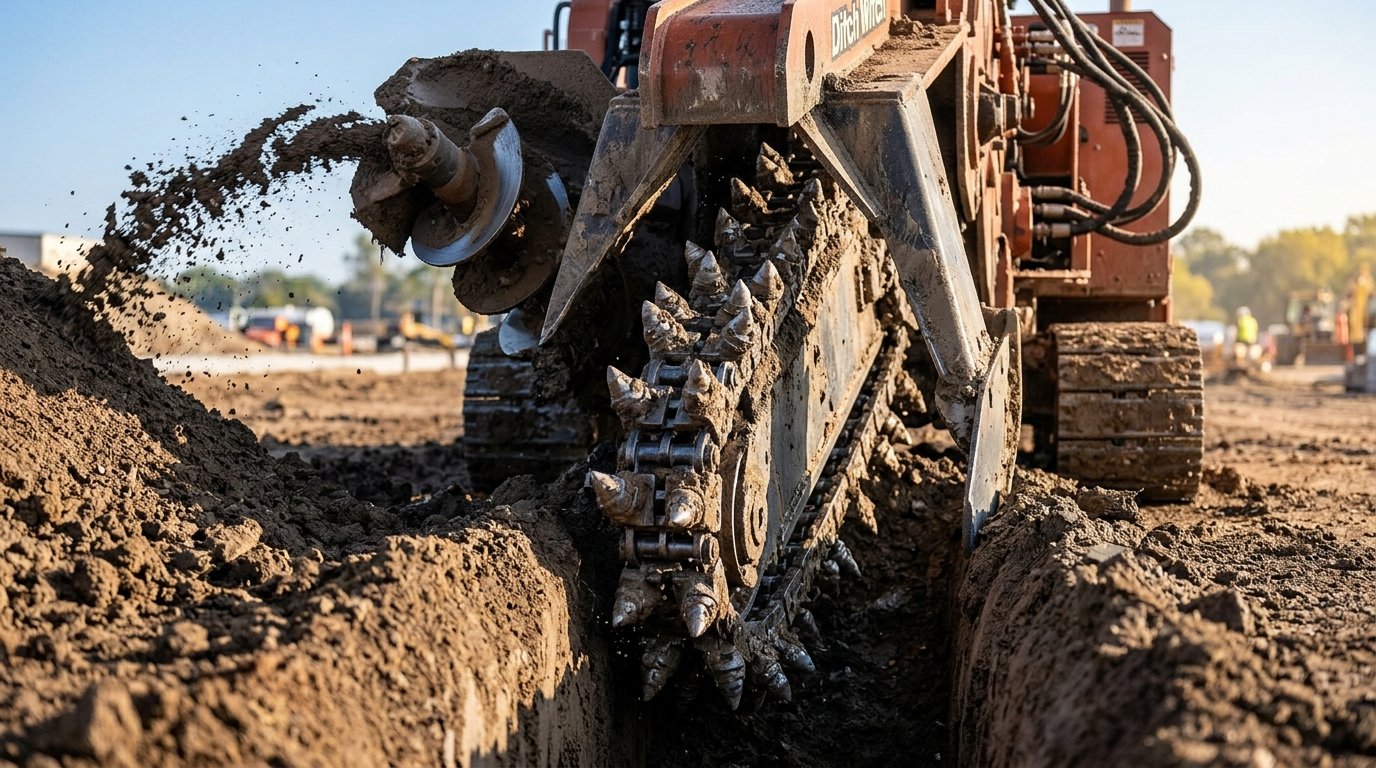
The cutting chain is a high-tensile alloy steel roller chain running over a heavy wear boom, carrying an array of specialized cutting teeth.
Deploying the wrong tooth geometry or chain pitch for a specific soil formation leads to immediate disaster: the chain stalls, teeth shatter, hydraulic oil overheats, and forward trenching velocity grinds to a dead halt.
Matching tooth metallurgy, tooth spacing, and hydraulic headshaft speed to ground geology is essential for profitable utility installation.
Tooth Geometries: Cup Cutters vs. Tungsten Carbide Rock Bits
1. Standard Cupped Teeth (Scoop Cutters) - **Geometry:** Curved, high-carbon steel shovel blades bolted to the chain brackets. - **Optimal Soil Formations:** Soft loam, sandy topsoil, agricultural dirt, and moist clay. - **Cutting Action:** Operates like miniature excavator buckets, cleanly scooping loose soil and conveying it up the boom to the discharge auger. - **Fatal Weakness:** In rocky soils or frozen ground, steel cup teeth bend, dull rapidly, and cause massive chain bounce.
2. Shark Teeth & Rotary Bullet Teeth (Tungsten Carbide) - **Geometry:** Heavy conical steel blocks capped with solid sintered **tungsten carbide tips**. - **Optimal Soil Formations:** Fractured shale, caliche, heavy gravel, asphalt, and frozen ground. - **Cutting Action:** Concentrates immense hydraulic impact force onto a razor-sharp carbide tip, shattering rock via brittle fracture rather than scooping. - **Rotary Action:** Bullet teeth rotate freely in their steel pockets as they strike rock, wearing evenly into a sharp conical point.
3. Combo 50/50 Chains (The Contractor's Favorite) - Alternates cup teeth and carbide bullet teeth along the chain links. The carbide teeth shatter the rock and hardpan, while the trailing cup teeth scoop the fractured spoil cleanly out of the trench.
Technical Chain Selection & Soil Geology Matrix
| Soil Geology Profile | Recommended Chain Configuration | Tooth Type | Chain Pitch Spacing | Expected Tooth Lifespan |
|---|---|---|---|---|
| **Loose Sand, Loam & Silt** | Full Cup Chain (100% Cupped) | Carbon Steel Cup Teeth | 2-Pitch (Every station loaded) | 400 - 800 Hours |
| **Dense Sticky Wet Clay** | Alternating Bare-Back Cup Chain | Self-Cleaning Cup Cutters | 4-Pitch (Spaced to avoid balling) | 300 - 600 Hours |
| **Hardpan, Caliche & Gravel** | 50/50 Alligator Combo Chain | Carbide Shark + Steel Cup | 2-Pitch Alternating | 150 - 300 Hours |
| **Solid Rock, Concrete & Asphalt** | Full Rock Frost Chain | Tungsten Carbide Bullet Picks | 2-Pitch Full Carbide Array | 80 - 200 Hours |
Chain Pitch Configuration: 2-Pitch vs. 4-Pitch
The spacing between cutting teeth on the roller chain—designated as **chain pitch**—directly dictates cutting resistance and soil evacuation:
Headshaft Speed & Ground Travel Modulation
Maximizing trenching speed requires balancing two independent hydraulic circuits: 1. **Chain Headshaft Speed (Cutting Circuit):** Governs how fast the chain orbits the boom (typically 350 to 500 feet per minute). 2. **Ground Drive Speed (Creep Circuit):** Governs how fast the machine creeps backward into the cut (typically 2 to 15 feet per minute).
If the ground drive pushes the boom into the face faster than the teeth can fracture the soil, the chain will jam, tripping the main hydraulic relief valve and stalling the engine. The operator must listen to diesel engine RPM and maintain a steady ground feed rate that holds engine speed within its peak torque band.
Frequently Asked Questions
Q: Why do trencher chains dig moving in reverse rather than forward? A: Continuous trenchers must always track backward while digging. This pulls the cutting teeth upward through the soil against the boom, using machine gross weight as a stable anchor and allowing the rotating auger to deposit clean spoil smoothly to the side of the open ditch.
Q: How do I know when a trencher chain is improperly tensioned? A: A properly tensioned chain should have approximately **1.5 to 2.5 inches of sag** beneath the middle of the boom when elevated horizontally. An overtightened chain robs engine horsepower and destroys boom nose roller bearings, while a loose chain will slap, climb the drive sprocket, and throw off the boom.
Q: Can a compact trencher cut through tree roots? A: Yes, provided it is equipped with a combo carbide chain. Carbide shark teeth slice through 4-inch hardwood tree roots effortlessly, whereas standard cup teeth will catch, stall the chain, and violently shake the machine.
Explore TYPHON PROPACT Mini Excavators & Skid Steers
Compare engine horsepower, hydraulic breakout forces, and operating weights across TERROR XVII PRO Cabin, TERROR III, IV, and STOMP 65 loaders.