Why a Scissor Lift Level Working Surface is Critical for Jobsite Safety
Understand the critical physics behind scissor lift stability, how a mere 3-degree grade causes elevated rollovers, and how to verify ground bearing capacity.
Understand the critical physics behind scissor lift stability, how a mere 3-degree grade causes elevated rollovers, and how to verify ground bearing capacity.
The Geometry of Elevated Tip-Over
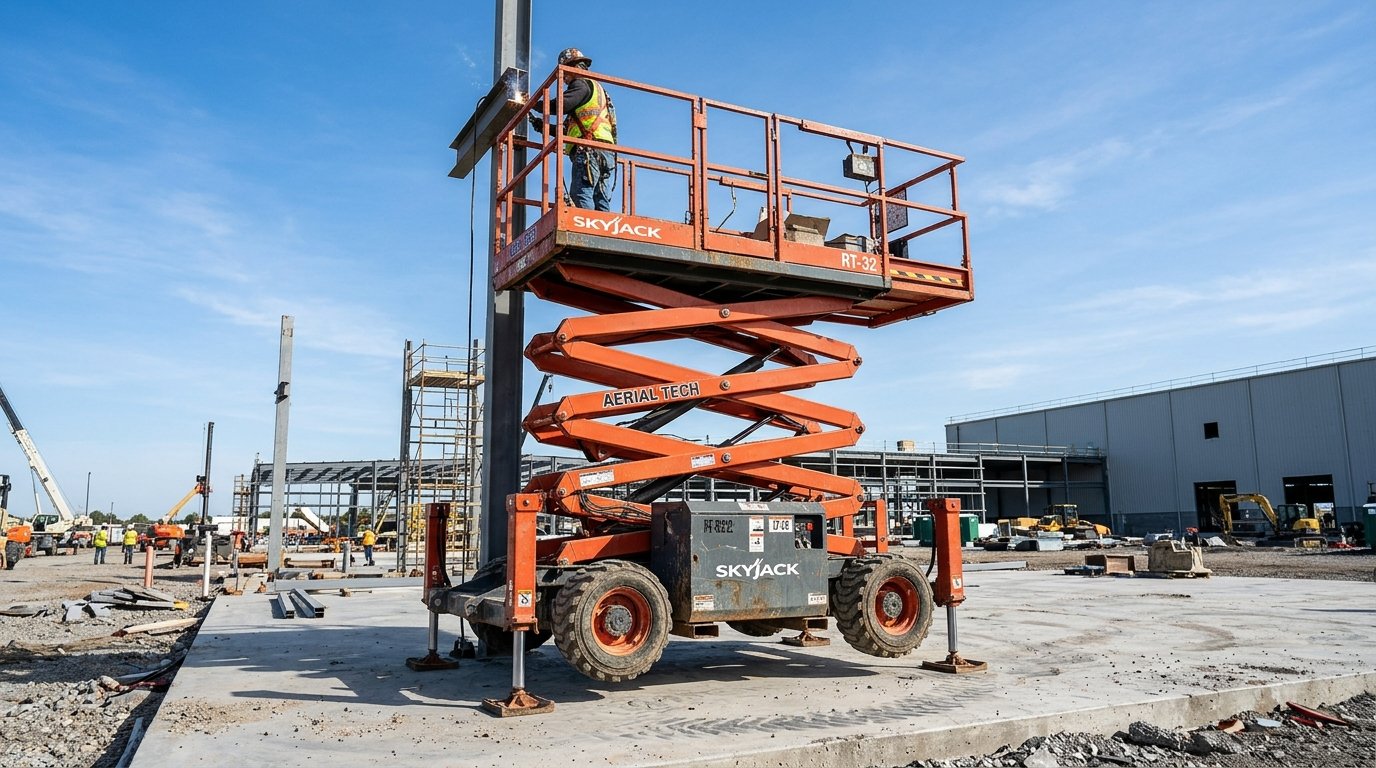
A scissor lift operating at an elevated height of 30 feet (9.1 meters) presents one of the most unforgiving geometric balance problems on any construction project.
Because the machine relies on a relatively narrow track width—frequently only 32 to 46 inches wide on slab models—any minor tilt angle at the wheel base translates to massive horizontal center-of-gravity displacement at the platform.
A base incline of just **3 degrees**, which is barely noticeable to an operator standing on the ground, shifts the platform's center of gravity outward by over **19 inches (48 cm)** at a 30-foot extension. When combined with dynamic wind loading, operator movement, and horizontal side forces, this displacement immediately exceeds the machine's tipping line, causing a catastrophic freefall rollover.
Mechanics of Stability Sensors & Automatic Cutouts
Modern ANSI/SAIA A92.20 compliant scissor lifts are equipped with dual-axis electronic tilt sensors that continuously monitor chassis level:
Technical Data: Tilt Angle vs. Platform Displacement
| Platform Elevation Height | Tilt Angle: 1.5° (Safe Zone) | Tilt Angle: 3.0° (Cutout Alarm) | Tilt Angle: 5.0° (Critical Rollover) |
|---|---|---|---|
| **19 ft (5.8 m)** | Lateral Shift: 6.0 in (15 cm) | Lateral Shift: 11.9 in (30 cm) | Lateral Shift: 19.8 in (50 cm) |
| **26 ft (7.9 m)** | Lateral Shift: 8.2 in (21 cm) | Lateral Shift: 16.3 in (41 cm) | Lateral Shift: 27.2 in (69 cm) |
| **32 ft (9.8 m)** | Lateral Shift: 10.1 in (26 cm) | Lateral Shift: 20.1 in (51 cm) | Lateral Shift: 33.5 in (85 cm) |
| **40 ft (12.2 m)** | Lateral Shift: 12.6 in (32 cm) | Lateral Shift: 25.1 in (64 cm) | Lateral Shift: 41.8 in (106 cm) |
Ground Bearing Capacity and Subsurface Hazards
Even on a visually horizontal surface, subsurface failure can instantly induce a deadly tilt. Always verify ground bearing capacity prior to elevation:
1. **Elevated Suspended Slabs:** Confirm that the building floor slab's allowable load rating (lbs/sq.ft) exceeds the total machine gross weight plus rated platform capacity. A 26-foot electric scissor lift weighs over 4,200 lbs distributed over four small solid rubber wheels. 2. **Hidden Trenches & Vaults:** Never position wheels near backfilled utility ditches, drainage trenches, or sewer inspection covers. Soft subgrade compaction can collapse under one wheel during elevation. 3. **Moisture & Frost Heave:** Wet soil or melting frost drastically lowers shear strength, causing sudden settlement under wheel loads exceeding 60 PSI.
Frequently Asked Questions
Q: Why does my scissor lift lift fine on the ground but stop driving when elevated? A: The pothole protection system and tilt sensors engage high-precision safety cutouts. If the sensor detects more than 1.5 degrees of chassis tilt while elevated, it locks out drive functions to prevent the machine from rolling into a deeper slope.
Q: Can I use wooden blocks or lumber under tires to level a scissor lift? A: No. OSHA standards explicitly forbid placing loose cribbing or lumber under tires to level a slab scissor lift. Only models equipped with manufacturer-certified outriggers with articulated steel pads are permitted to level on grade.
Q: What is the maximum wind speed allowed for outdoor scissor lift operation? A: Most outdoor-rated scissor lifts have a maximum permissible wind speed rating of 28 mph (12.5 m/s). Many indoor slab lifts are rated for 0 mph wind and must never be operated outdoors exposed to wind gusts.
Explore TYPHON PROPACT Mini Excavators & Skid Steers
Compare engine horsepower, hydraulic breakout forces, and operating weights across TERROR XVII PRO Cabin, TERROR III, IV, and STOMP 65 loaders.
More Equipment Guides