Excavator Boom Swing Angle vs. House Swing: Technical Differences & Field Use
Master the engineering distinctions between independent boom swing and 360-degree house swing, zero tail swing dynamics, and wall-hugging excavation.
Master the engineering distinctions between independent boom swing and 360-degree house swing, zero tail swing dynamics, and wall-hugging excavation.
The Articulation Dilemma: House Slew vs. Boom Offset
Operators transitioning from full-size civil excavators (15–30 tons) to compact mini excavators (1–8 tons) often encounter an unfamiliar control function: the **independent boom swing pedal or thumb roller**.
On large production excavators, the boom is bolted rigidly to the upper rotating platform (the house). To change trenching angle, the entire house must rotate 360 degrees via the main hydraulic slew motor and bearing ring.
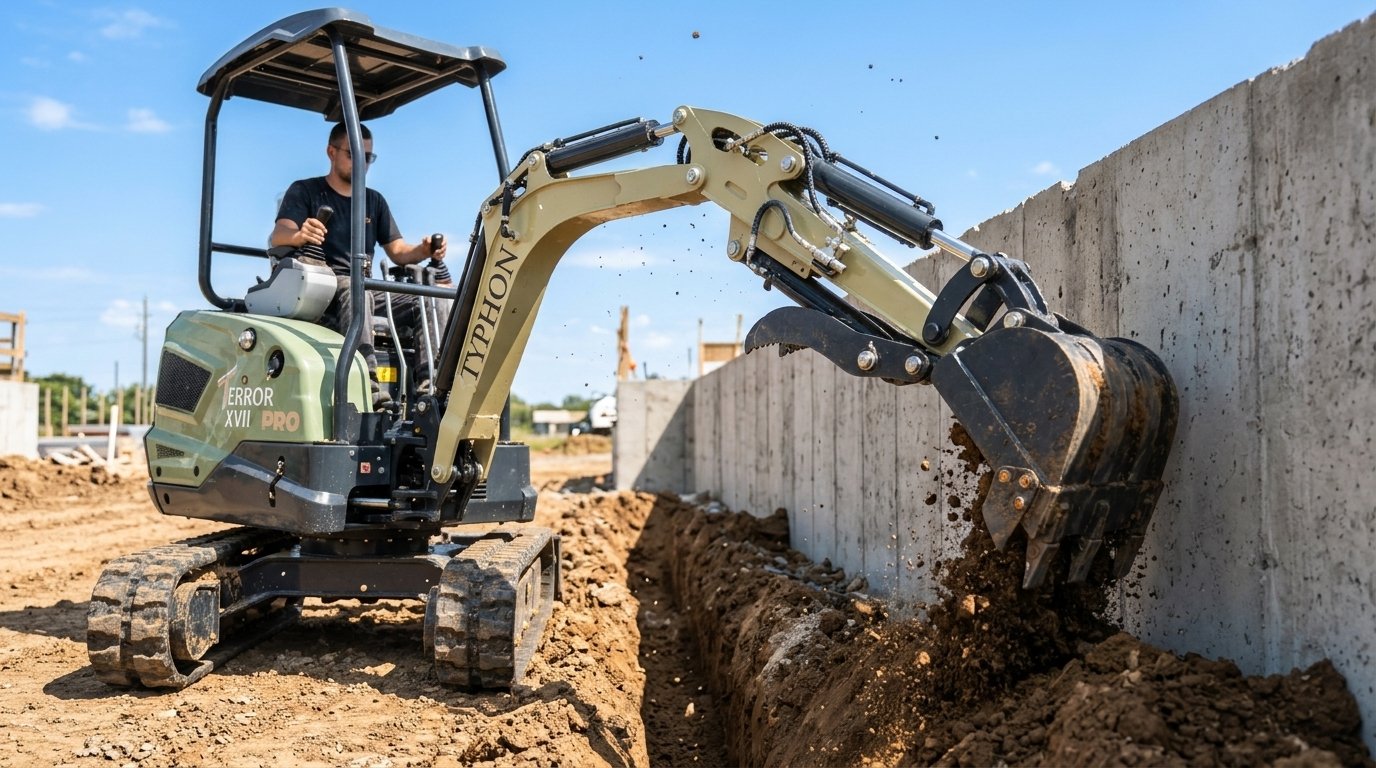
Conversely, advanced compact excavators like the **TYPHON TERROR XVII PRO** feature a heavy-duty cast pivot knuckle between the house and boom base, driven by a dedicated hydraulic cylinder. This mechanism permits the digging boom to swing independently to the left and right while the tracks and operator cab remain completely stationary.
Key Engineering Differences
1. House Swing (Slew Drive) - **Mechanism:** A hydraulic axial piston motor driving a planetary gearbox with a pinion gear meshed into the 360-degree slew ring bearing. - **Rotation Range:** Unlimited continuous 360-degree rotation in both clockwise and counter-clockwise directions. - **Torque & Speed:** High rotational inertia, typical slew speeds ranging from 8 to 11 RPM. - **Clearance Consideration:** On conventional tail-swing excavators, the counterweight swings beyond the track width, posing severe collision hazards with walls, trees, and passing traffic.
2. Independent Boom Swing - **Mechanism:** A heavy double-acting hydraulic ram mounted horizontally or vertically beneath the cab footwell, connected to a heavy steel kingpin knuckle. - **Rotation Range:** Limited articulation angle—typically **50° to 65° to the left**, and **50° to 60° to the right**. - **Torque & Precision:** High-precision positioning optimized for parallel offset trenching alongside foundations, fences, and roadway barriers.
Technical Comparison Matrix
| Specification / Dynamic | Independent Boom Swing Feature | 360° Upperstructure House Swing |
|---|---|---|
| **Motion Type** | Angular articulation via hydraulic ram | Continuous 360° rotation via slew motor |
| **Typical Swing Angle Range** | 50°–65° Left / 50°–60° Right | Infinite 360° Continuous |
| **Primary Structural Component** | Kingpin pivot knuckle & hydraulic ram | Slew ring bearing & planetary pinion gear |
| **Excavator Class Availability** | 0.8 Ton to 8.5 Ton (Mini/Midi) | All excavators (0.8 Ton to 100+ Ton) |
| **Offset Trenching Capability** | Can trench flush along parallel walls | Requires repositioning tracks diagonally |
| **Impact on Machine Stability** | Tilts bucket breakout force off-center | Centers digging force directly along house axis |
Field Applications: When to Leverage Independent Boom Swing
Foundation Trenching Flush Against Structures When digging a perimeter footing directly against an existing building wall, a conventional excavator cannot dig parallel without rotating its cab into the brickwork. With boom swing, the operator aligns the tracks parallel to the wall, articulates the boom 50 degrees toward the structure, and excavates a pristine straight trench while maintaining 100% counterweight clearance.
Underground Utility Straddling When navigating buried fiber optic cables, water mains, or gas conduits, the boom swing enables fine bucket adjustments without shifting the undercarriage. This avoids rutting landscaped yards and prevents costly track repositioning cycles.
Loading Trucks in Confined Single-Lane Alleys In narrow urban alleys where zero tail swing is insufficient, swinging the boom to discharge aggregate directly into a high-sided trailer saves thousands of slew motor operating hours and eliminates rear counterweight strike hazards.
Frequently Asked Questions
Q: Does digging with the boom swung at an angle reduce breakout force? A: Yes. When the boom is articulated 50 degrees to the side, hydraulic digging forces create torsional twisting moments on the excavator undercarriage rather than directing force straight into the stabilizer blade. Expect a 15% to 20% reduction in effective ground penetration force when digging off-axis.
Q: How often should the boom swing kingpin pivot be greased? A: The boom swing pivot knuckle experiences massive cyclic shear stress. It should be greased daily (every 8 to 10 operating hours) with high-pressure molybdenum-disulfide lithium grease to prevent kingpin bushing play.
Q: Why do 20-ton excavators lack independent boom swing? A: At 20+ tons, the immense breakout forces (exceeding 30,000 lbs) would snap a pivot knuckle under heavy shock loads. Heavy excavators rely on rigid boom mounts and dedicated side-tilt ditching buckets to achieve angled excavation.
Explore TYPHON PROPACT Mini Excavators & Skid Steers
Compare engine horsepower, hydraulic breakout forces, and operating weights across TERROR XVII PRO Cabin, TERROR III, IV, and STOMP 65 loaders.