Scissor Lift vs. Forklift: Choosing the Right Equipment for Elevated Work
Comparing scissor lifts and forklifts: analyze working height, platform payload capacity, OSHA safety regulations, and jobsite cost factors.
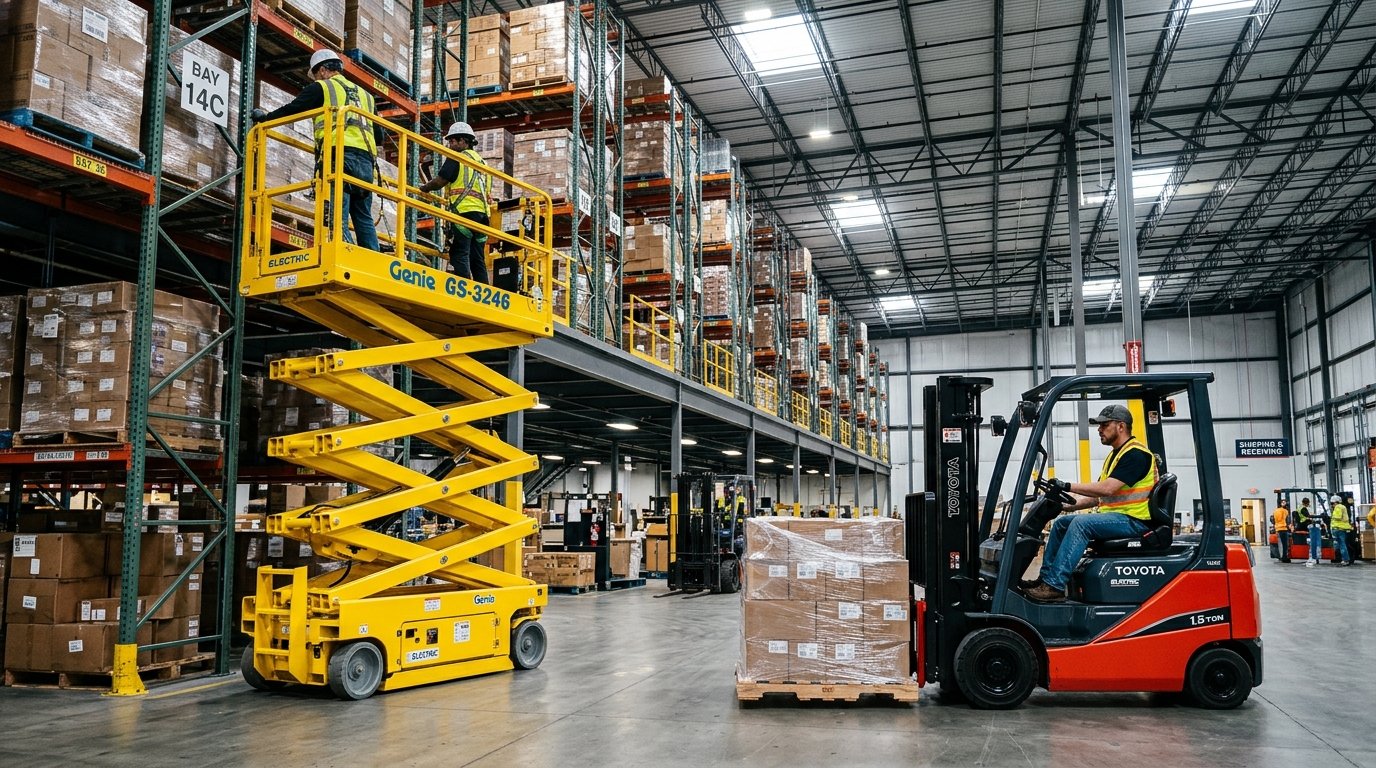
Comparing scissor lifts and forklifts: analyze working height, platform payload capacity, OSHA safety regulations, and jobsite cost factors.
Defining the Mission: Personnel Elevation vs. Material Logistics
When planning elevated jobsite tasks—whether erecting high-bay warehouse racking, installing MEP ductwork, or servicing overhead crane rails—site managers must select the right machine for the mission.
A common operational error is attempting to adapt a forklift for personnel access using aftermarket basket attachments, or conversely, utilizing a scissor lift as a makeshift crane to hoist heavy steel beams.
Both machines provide vertical lifting capabilities, but their core design philosophies, safety standards, and hydraulic load charts are fundamentally different. Understanding these engineering differences guarantees both regulatory compliance and peak productivity.
Primary Functional Distinctions
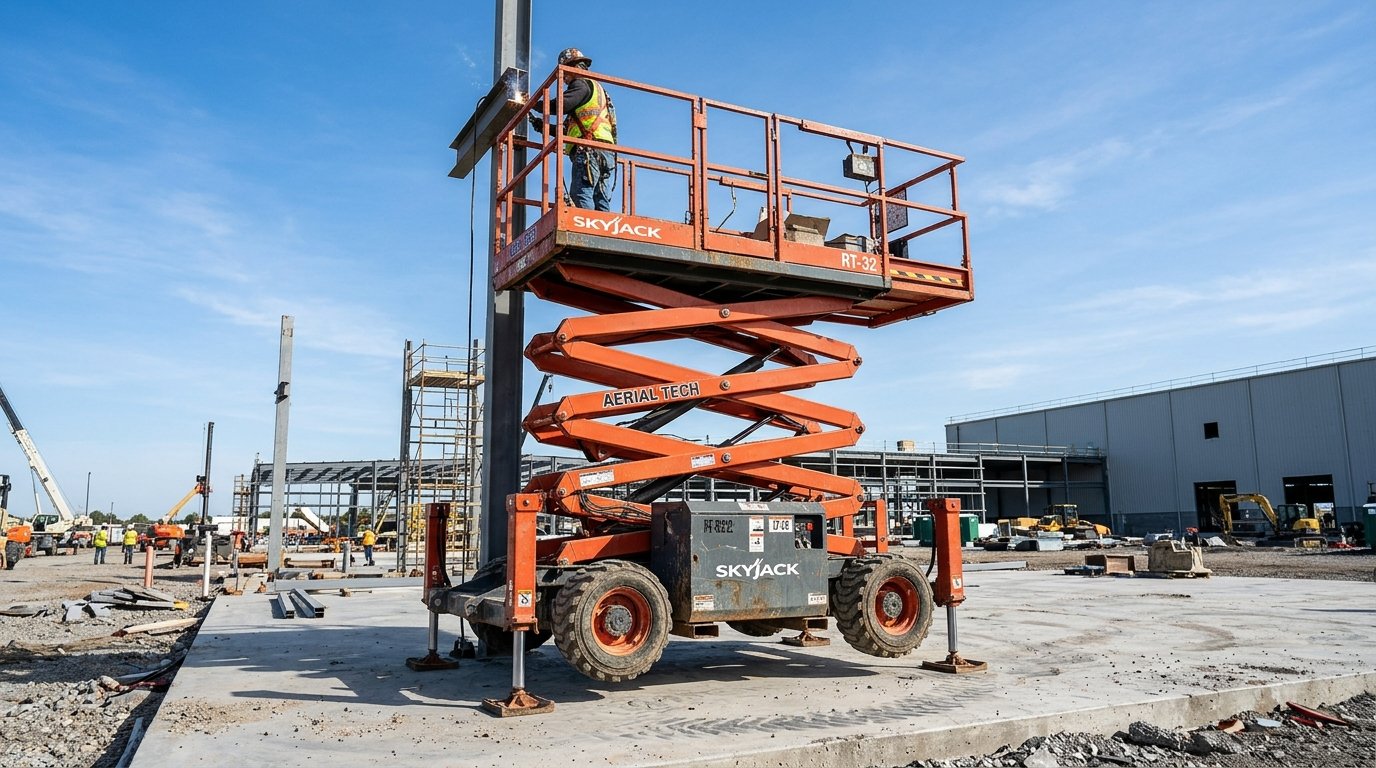
Scissor Lifts: Engineered for Safe Personnel Elevation Scissor lifts are classified as Mobile Elevating Work Platforms (MEWP) under ANSI/SAIA A92.20 and ISO 16368. They utilize crisscrossing pantograph steel linkages propelled by hydraulic cylinders or electric ball screws to raise a stable, railed working deck vertically. - **Core Purpose:** Transporting technicians, small toolkits, and light components directly to overhead work points. - **Working Heights:** Typically 19 ft (5.8 m) up to 53 ft (16.2 m). - **Platform Capacities:** 500 lbs (227 kg) to 1,500 lbs (680 kg).
Forklifts: Engineered for High-Density Palletized Cargo Forklifts (Powered Industrial Trucks under OSHA 1910.178) utilize a vertical telescopic mast with roller chains and hydraulic lift cylinders to elevate heavy forks. - **Core Purpose:** Lifting, stacking, and transporting palletized materials, structural bundles, and containerized freight. - **Lifting Capacities:** 3,000 lbs (1,360 kg) to over 36,000 lbs (16,300 kg). - **Working Reach:** Up to 18 ft (5.5 m) on standard counterbalance units, and up to 55 ft (16.8 m) on rough-terrain telehandlers.
Technical Comparison Matrix
| Specification / Attribute | Slab Electric Scissor Lift (e.g. 2632) | Counterbalance Forklift (Class I / IV) | Rough Terrain Telehandler |
|---|---|---|---|
| **Primary Regulatory Standard** | ANSI/SAIA A92.20 / CSA B354.6 | OSHA 29 CFR 1910.178 | OSHA 29 CFR 1926.602 / ANSI B56.6 |
| **Max Platform / Lift Height** | 26 - 32 ft (7.9 - 9.8 m) | 15 - 19 ft (4.5 - 5.8 m) | 42 - 56 ft (12.8 - 17.1 m) |
| **Safe Working Load (SWL)** | 500 - 800 lbs (227 - 363 kg) | 4,000 - 6,000 lbs (1,814 - 2,720 kg) | 6,000 - 10,000 lbs (2,720 - 4,535 kg) |
| **Personnel Elevation Legal?** | Yes, fully certified | Only with approved safety cage | Only with integrated radio basket |
| **Ground Surface Requirement** | Flat concrete (max 2° slope) | Smooth slab to compacted gravel | Unimproved mud, rock, and ruts |
| **Turning Radius** | Zero inside turning radius | 6.5 - 8.5 ft (2.0 - 2.6 m) | 12 - 15 ft (3.6 - 4.6 m) |
Jobsite Selection Workflow
1. **Evaluate Load Composition:** If the primary payload consists of human technicians requiring a wide stable deck to maneuver tools, select a scissor lift. If the payload is palletized materials exceeding 1,000 lbs, select a forklift or telehandler. 2. **Inspect Jobsite Ground Conditions:** Electric slab scissor lifts require level, hard-finished surfaces with less than 2-degree incline. For unimproved dirt or gravel grades, you must deploy a 4x4 Rough Terrain (RT) scissor lift with self-leveling outriggers or a rough-terrain telehandler. 3. **Verify OSHA Restraint Requirements:** Scissor lift operators require 42-inch top guardrails, midrails, and 4-inch toeboards. In contrast, any personnel basket hoisted by a forklift requires a fully secured harness lanyard anchored to certified points.
Frequently Asked Questions
Q: Can I legally lift personnel using a forklift with a wooden pallet? A: Absolutely NOT. OSHA 1910.178 strictly prohibits elevating workers on pallets or makeshift platforms. Personnel may only be elevated using an engineered, manufacturer-approved safety basket with full guardrails and secure mast chain lockouts.
Q: Why do scissor lifts have lower lifting capacities than forklifts? A: Scissor linkages experience severe lateral deflection and buckling stresses at elevated heights. To prevent structural failure and maintain a mandatory 3:1 safety stability factor without heavy counterweights, their payloads are engineered for technician loads under 1,500 lbs.
Q: Which machine is more economical to rent for warehouse lighting retrofit? A: An electric slab scissor lift is significantly cheaper and more efficient. It allows the electrician to drive while elevated, carries an integrated work deck, and maneuvers down tight 36-inch aisles where a forklift cannot turn.
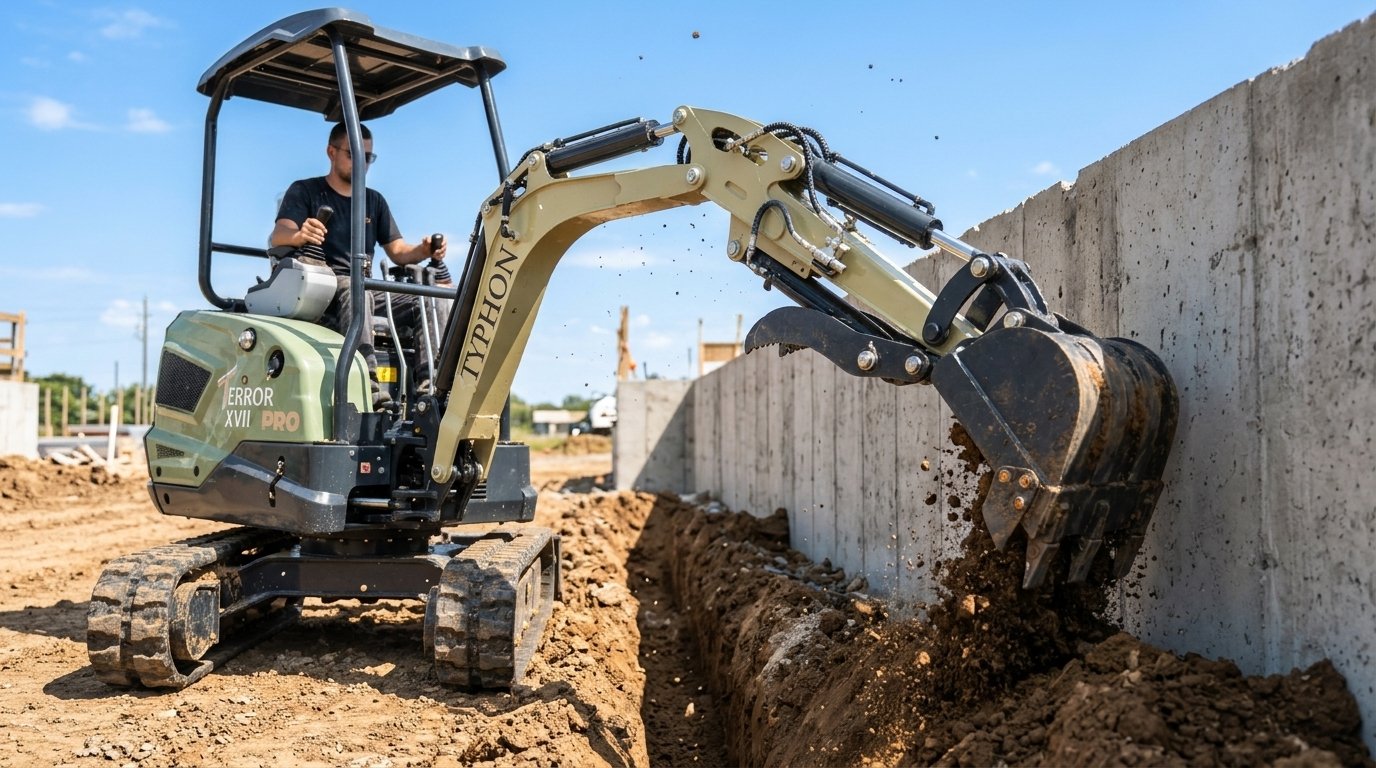
Explore TYPHON PROPACT Mini Excavators & Skid Steers
Compare engine horsepower, hydraulic breakout forces, and operating weights across TERROR XVII PRO Cabin, TERROR III, IV, and STOMP 65 loaders.
More Equipment Guides