Forklift Load Positioning, Center of Gravity & Mast Tilt for Maximum Stability
Master the forklift stability triangle: analyze combined center of gravity, forward vs backward mast tilt, dynamic braking hazards, and slope travel rules.
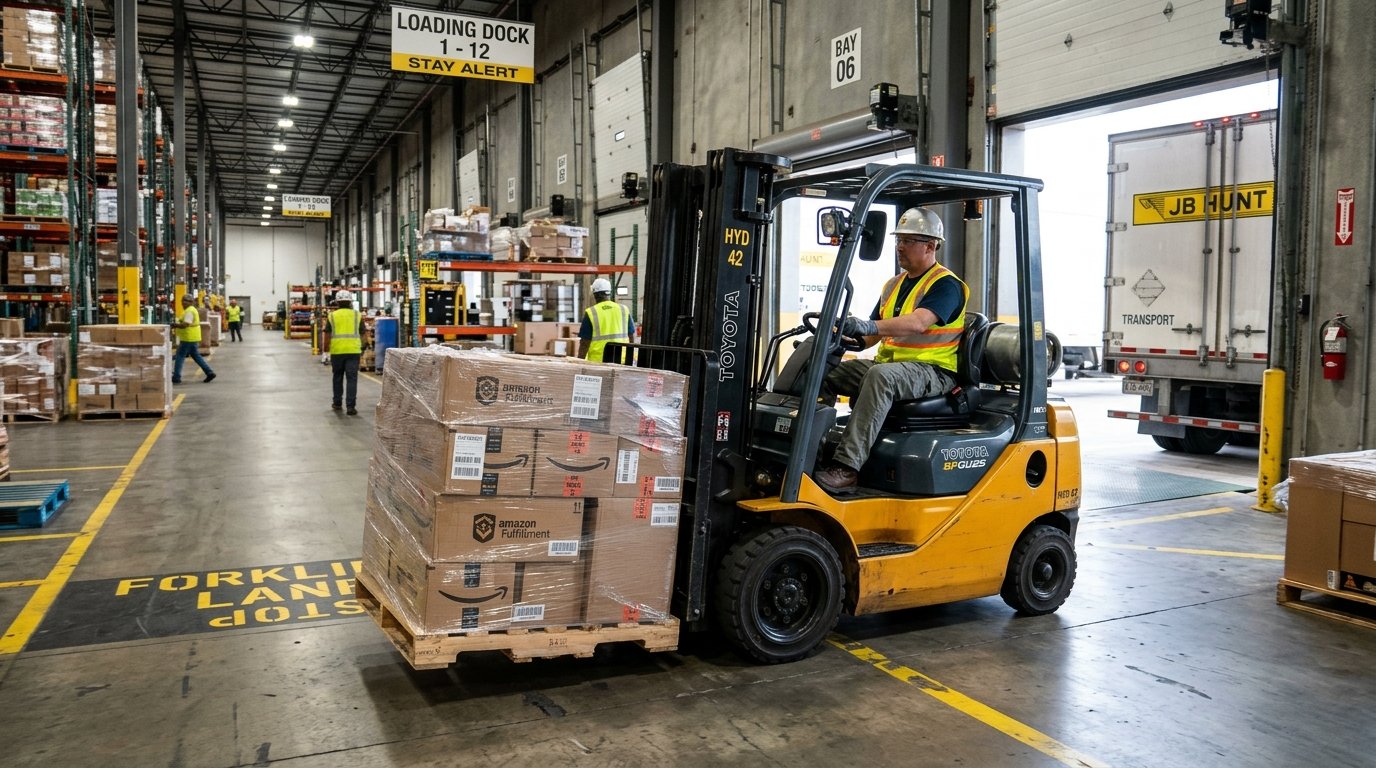
Master the forklift stability triangle: analyze combined center of gravity, forward vs backward mast tilt, dynamic braking hazards, and slope travel rules.
The Physics of the Forklift Stability Triangle
Forklifts (Powered Industrial Trucks) are engineered with an entirely unique chassis geometry that makes them fundamentally different from road vehicles.
Unlike a car, which has a wide, rectangular four-point suspension, a counterbalance forklift features a **three-point suspension system**: the two front drive wheels and the center pivot pin of the rear steering axle.
These three points form what material handling engineers designate as the **Stability Triangle**.
As long as the machine's **Combined Center of Gravity (Combined CoG)**—which unites the weight of the forklift and the weight of the cargo—remains within the boundary lines of this triangle, the machine remains upright.
However, improper load positioning, reckless mast tilting, or turning with an elevated mast moves the combined CoG outside the triangle, inducing an instantaneous tip-over.
Critical Rules for Load Positioning & Transport
1. The 4-to-6 Inch Travel Height Rule The single most critical rule in forklift operation: **NEVER travel with the mast elevated**. - When carrying a load, the forks must be maintained **4 to 6 inches (10 to 15 cm) off the ground**, just high enough to clear surface obstacles. - An elevated load shifts the center of gravity up near the mast head, drastically shrinking the stable perimeter of the triangle. Turning at just 3 mph with an elevated load will roll a forklift onto its side.
2. Mast Tilt Protocol: Full Back-Tilt During Travel - **Travel Position:** Once the load is secured against the fork carriage backrest, tilt the mast **fully backward**. This shifts the load's center of gravity rearward over the front drive axle and deep inside the stability triangle. - **Forward Tilt Warning:** Forward tilt should ONLY be utilized when the forklift is completely stationary over a rack or stack to gently deposit a pallet. Traveling with forward tilt drastically increases the leverage arm of the load, causing the rear steer wheels to lose contact with the floor.
3. Traversing Slopes & Incline Gradients When navigating ramps, loading docks, or hills, gravity dictates machine orientation: - **When Loaded:** Always travel with the load facing **UPHILL**. Climb driving forward; descend driving in reverse. - **When Unloaded:** Always travel with the counterweight facing **UPHILL**. Climb in reverse; descend driving forward. - **Never Turn on a Ramp:** Turning on any sloped grade immediately rolls the forklift onto its side.
Technical Load Center & Derating Reference
| Pallet Dimensions / Load Center | Rated Capacity (5,000 lb Base) | Actual Safe Working Load | Dynamic Tip Risk Factor |
|---|---|---|---|
| **48" x 48" Pallet (24" Load Center)** | 5,000 lbs (2,268 kg) | **5,000 lbs (100% Full Rating)** | Baseline Standard Stability |
| **60" x 60" Pallet (30" Load Center)** | 5,000 lbs (2,268 kg) | **4,000 lbs (20% Derated)** | Moderate (Increased Forward Tip Risk) |
| **72" x 72" Pallet (36" Load Center)** | 5,000 lbs (2,268 kg) | **3,330 lbs (33% Derated)** | High (Severe Loss of Steer Axle Grip) |
| **96" Long Bundles (48" Load Center)** | 5,000 lbs (2,268 kg) | **2,500 lbs (50% Derated)** | Extreme (Guaranteed Tip Over Under Hard Braking) |
Dynamic Braking Hazards & Centrifugal Tip-Over Forces
Even at legal warehouse speeds of 5 to 7 MPH, dynamic kinetic forces drastically alter load stability:
Frequently Asked Questions
Q: What should an operator do if a forklift begins to roll over? A: **STAY INSIDE THE CAB!** Never attempt to jump clear. Over 85% of forklift fatalities occur when jumping operators are crushed by the overhead guard (the "mousetrap effect"). Hold the steering wheel tightly, brace your feet firmly against the floorboards, and lean AWAY from the direction of the fall.
Q: What does "24-inch load center" mean on a forklift data plate? A: The load center is the horizontal distance from the vertical face of the fork tines to the center of gravity of the load. Standard industrial pallets measure 48 inches deep, placing the center of gravity exactly at 24 inches.
Q: Why do forks need to be spaced as wide as possible? A: Wide fork spacing provides maximum lateral stability under the pallet, preventing the load from rocking or tipping off-center during turns or floor bumps.
Explore TYPHON PROPACT Mini Excavators & Skid Steers
Compare engine horsepower, hydraulic breakout forces, and operating weights across TERROR XVII PRO Cabin, TERROR III, IV, and STOMP 65 loaders.