How Workload, Trench Depth & Operator Technique Dictate Mini Excavator Fuel Efficiency
Discover how engine throttle settings, trench depth, soil composition, and operator technique reduce mini excavator fuel consumption by up to 25%.
Discover how engine throttle settings, trench depth, soil composition, and operator technique reduce mini excavator fuel consumption by up to 25%.
The Hidden Margin: Operating Technique vs. Gallons Per Hour
With diesel fuel prices representing one of the largest ongoing variable costs for civil earthmoving contractors, optimizing equipment fuel efficiency is essential for jobsite profitability.
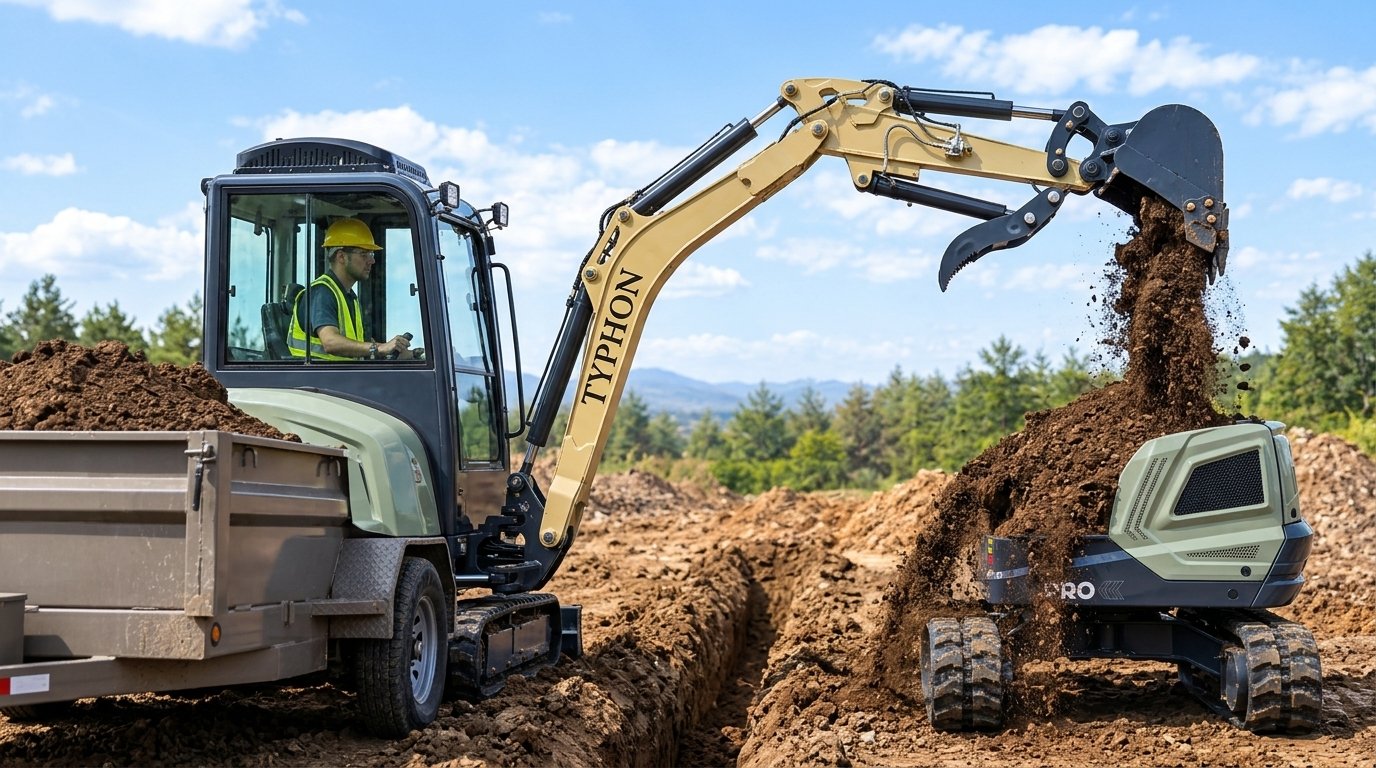
In a compact excavator fleet, such as the **TYPHON TERROR series**,, fuel consumption typically fluctuates between **0.4 and 1.8 gallons per hour (GPH)**.
While engine displacement and Tier 4 emissions calibration establish baseline efficiency, field telemetry audits prove that **workload dynamics and operator technique account for over a 30% swing in actual fuel burn**.
Running an excavator engine pinned at maximum throttle against relief valves wastes horsepower, converts expensive diesel into wasted hydraulic heat, and accelerates engine carbon fouling.
Key Factors Influencing Mini Excavator Fuel Burn
1. Engine Throttle & Eco-Mode Calibration Most modern compact excavators feature variable work modes (e.g., Eco Mode vs. Power Mode). - **Power Mode (Max RPM):** The engine operates at 2,400–2,600 RPM. This is only necessary when breaking heavy rock with a hydraulic hammer or traversing steep hills. - **Eco Mode (Reduced RPM):** RPM is dialed down by 15% to 18% (e.g., 2,000 RPM) while the variable-displacement hydraulic pump compensates by increasing piston stroke displacement. Digging speed remains 90% identical, but fuel consumption drops by **18% to 24%**.
2. Auto-Idle Systems & Extended Idling Waste On typical utility jobsites, an excavator spends **35% to 50% of its engine run time idling** while operators await dump trucks, grade lasers, or pipe laying. - Auto-idle systems automatically drop engine speed to low idle (900 RPM) after 4 to 5 seconds of control inactivity. - Eliminating unnecessary idling preserves diesel particulate filter (DPF) life, reduces unburned hydrocarbon soot, and saves 0.2 to 0.4 gallons per hour of non-productive fuel burn.
3. Digging Depth & Bucket Fill Factors The angle of the excavator boom and arm relative to the ground profoundly impacts hydraulic digging resistance: - Excavating at 80% to 100% of maximum dig depth forces hydraulic cylinders to operate at unfavorable mechanical leverage angles, drawing maximum relief pressure. - An experienced operator trenches in continuous horizontal layers matching the bucket's optimum cutting angle, achieving a 100% full bucket heap in a single pass without dragging the bucket through dead soil.
Technical Fuel Consumption Matrix by Excavator Class
| Excavator Class | Engine Displacement | Light Grading / Clean-Up | Continuous Trenching | Heavy Rock / Breaker Work |
|---|---|---|---|---|
| **1.0 - 1.8 Ton Class** | 0.8L - 1.1L (12 - 16 HP) | 0.35 - 0.45 GPH (1.3 - 1.7 L/h) | 0.50 - 0.65 GPH (1.9 - 2.5 L/h) | 0.70 - 0.90 GPH (2.6 - 3.4 L/h) |
| **2.5 - 3.8 Ton Class** | 1.5L - 1.8L (20 - 28 HP) | 0.60 - 0.75 GPH (2.3 - 2.8 L/h) | 0.85 - 1.15 GPH (3.2 - 4.3 L/h) | 1.30 - 1.65 GPH (4.9 - 6.2 L/h) |
| **5.0 - 6.5 Ton Class** | 2.2L - 3.3L (45 - 60 HP) | 1.10 - 1.40 GPH (4.2 - 5.3 L/h) | 1.60 - 2.10 GPH (6.0 - 7.9 L/h) | 2.40 - 3.20 GPH (9.1 - 12.1 L/h) |
Field Strategies for Cutting Fleet Fuel Consumption
1. **Avoid Hitting Cylinder Stroke Reliefs:** When crowding the stick or curling the bucket to its mechanical travel stop, holding the joystick forces pressurized oil over the main relief valve. This spikes fuel burn instantly and generates zero productive work. 2. **Keep the Undercarriage Level:** Operating on an unlevel slope forces the slew motor to push the heavy boom uphill on every single swing cycle, increasing swing circuit fuel burn by over 40%. Grade a level work pad before initiating production digging. 3. **Maintain Sharp Bucket Teeth:** Worn, blunt bucket teeth require 35% higher tractive breakout force to penetrate cohesive soil, forcing hydraulic pumps into high-pressure relief ranges.
Frequently Asked Questions
Q: Does operating in Eco-Mode slow down daily trenching production? A: In standard soil and loam, no. Modern load-sensing hydraulic systems deliver identical hydraulic flow at 2,000 RPM as they do at 2,400 RPM for standard bucket curling. You only notice a minor speed reduction when attempting triple combined motions in heavy rock.
Q: Why does poor air filtration increase diesel consumption? A: A clogged engine air filter restricts intake airflow, starving the diesel cylinders of oxygen. The engine control module (ECM) compensates by over-fueling, resulting in unburned black smoke, rapid DPF soot accumulation, and a 10% to 15% drop in thermal efficiency.
Q: How much fuel is wasted by tracking the excavator across long distances? A: Travel motors require massive continuous hydraulic flow. Tramming an excavator across a large jobsite burns fuel at nearly twice the rate of stationary digging. For distances over 300 feet, transport the machine using a trailer or utility truck.
Explore TYPHON PROPACT Mini Excavators & Skid Steers
Compare engine horsepower, hydraulic breakout forces, and operating weights across TERROR XVII PRO Cabin, TERROR III, IV, and STOMP 65 loaders.