Does Mast Height Affect Forklift Engine Power? Hydraulic Pressure & Duty Cycles
Debunking the myth: how mast height affects hydraulic cylinder staging, oil flow requirements, lift speeds, and load capacity derating.
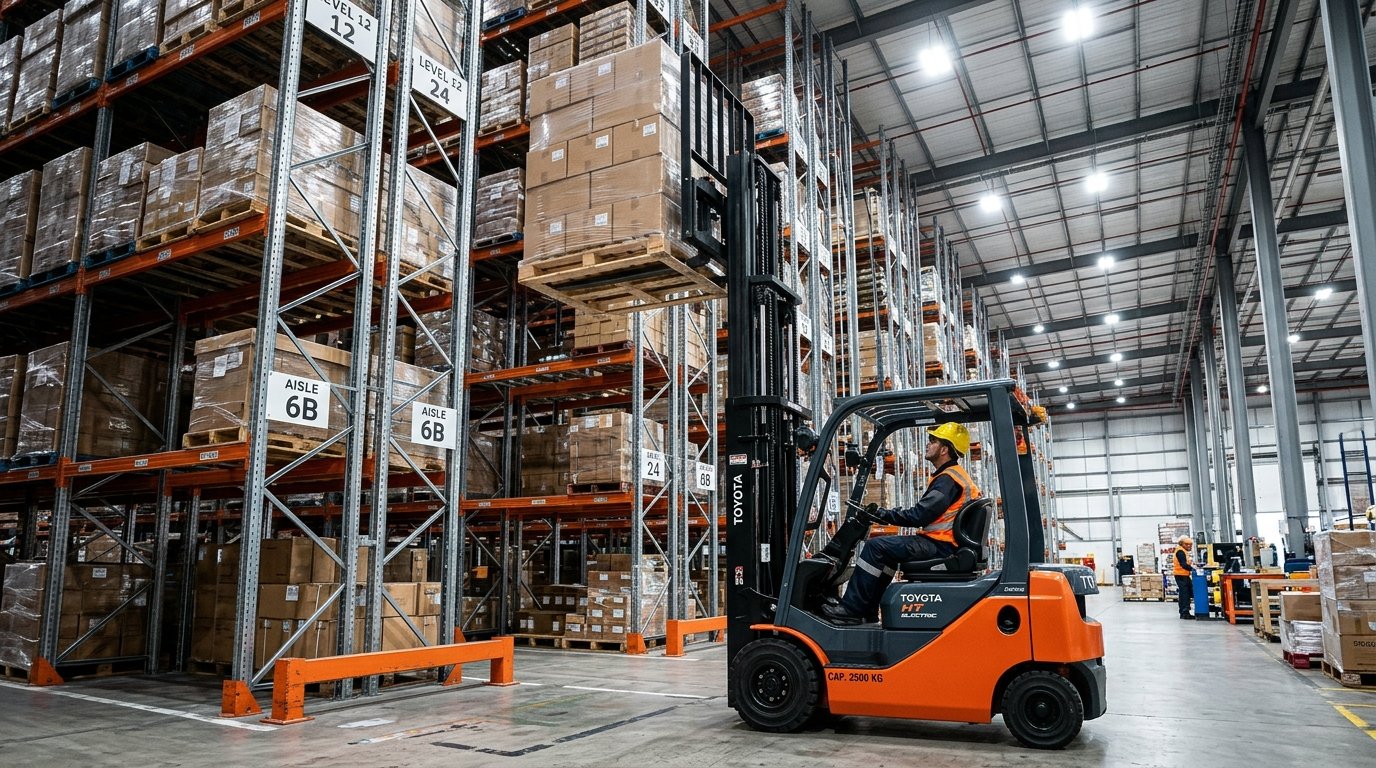
Debunking the myth: how mast height affects hydraulic cylinder staging, oil flow requirements, lift speeds, and load capacity derating.
Demystifying Mast Height and Engine Displacement
A widespread misconception among warehouse supervisors and equipment buyers is that specifying a taller mast on a forklift necessitates a significantly larger, higher-horsepower engine.
From an engineering perspective, this is fundamentally false.
The hydraulic pressure required to lift a 5,000 lb pallet does **not** increase as the mast rises. Whether that pallet is 2 inches off the ground or elevated 20 feet in the air, the fluid pressure required inside the hydraulic lift cylinders remains essentially constant: it is dictated solely by the cross-sectional area of the hydraulic pistons and the weight of the load.
However, mast height drastically impacts **hydraulic fluid volume, multi-stage friction, pump duty cycles, and rated lifting capacity**. Understanding these factors prevents costly fleet purchasing missteps.
The True Engineering Impacts of Mast Height
1. Hydraulic Flow Volume & Lift Cycle Times While pressure remains constant, a taller mast requires a vastly greater volume of hydraulic fluid to fully extend the telescopic cylinders. - A standard 2-stage (simplex) mast elevating to 130 inches requires approximately 2.5 gallons of oil displacement. - A 3-stage (triplex) or 4-stage (quad) mast extending to 240 inches requires over 5.5 gallons of oil displacement. Because engine horsepower dictates how many gallons per minute (GPM) the hydraulic gear pump can deliver without stalling, a smaller engine will simply lift the taller mast at a slower feet-per-minute rate.
2. Multi-Stage Roller Friction and Parasitic Losses As a triplex or quad mast extends, the nested steel I-beam channels slide on precision shims and sealed roller bearings. When lifting near maximum height under full load, mechanical deflection induces parasitic friction. This requires a minor hydraulic pressure reserve (typically 150–250 PSI higher) to overcome channel resistance.
3. Load Capacity Derating (The Stability Triangle) While the engine and hydraulic system have zero trouble hoisting the weight, the **forklift chassis capacity derates significantly with height**. As a load ascends beyond 15 feet, the forklift's combined center of gravity moves outward and upward. To prevent forward tip-over, manufacturers derate a nominal 5,000 lb forklift to 3,400 lbs or less at full mast extension.
Technical Specifications: Mast Type vs. Performance Metrics
| Mast Configuration Type | Max Lift Height (MFH) | Collapsed Overall Height (OAL) | Free Lift Capability | Typical Capacity Derating @ Max Height |
|---|---|---|---|---|
| **Single-Stage (Simplex)** | 100 - 120 in (2.5 - 3.0 m) | 80 - 90 in (2.0 - 2.3 m) | None (0 inches) | 0% (Full 100% rated capacity) |
| **Two-Stage (Duplex)** | 130 - 150 in (3.3 - 3.8 m) | 85 - 95 in (2.1 - 2.4 m) | Full Free Lift (55 in) | 0% - 5% Derating |
| **Three-Stage (Triplex)** | 189 - 216 in (4.8 - 5.5 m) | 85 - 95 in (2.1 - 2.4 m) | Full Free Lift (60 in) | 15% - 25% Derating |
| **Four-Stage (Quad)** | 240 - 276 in (6.1 - 7.0 m) | 90 - 105 in (2.3 - 2.7 m) | Full Free Lift (65 in) | 30% - 45% Derating |
Electric vs. Internal Combustion Duty Cycle Considerations
On internal combustion (diesel/LPG) forklifts, high mast cycles merely demand consistent engine throttle to maintain high pump RPM during lifting.
On **electric battery-powered forklifts**, however, continuous high-mast cycling places heavy sustained current draws on the traction and pump inverters:
Frequently Asked Questions
Q: Will buying a higher-horsepower forklift allow me to lift heavier loads at full mast height? A: No! Engine horsepower has zero influence on the stability derating chart. Overloading a forklift at maximum mast extension will cause the rear steer wheels to lift off the floor, inducing an immediate forward rollover regardless of engine size.
Q: What is "Free Lift" and why does it matter in container loading? A: Free lift is the vertical distance the forks can rise before the inner mast channels extend past the top of the outer mast. Full free lift is critical inside low-clearance boxcars and shipping containers so you can stack pallets without smashing the mast into the ceiling.
Q: Why do tall masts shudder or sway when stopping abruptly? A: Steel mast rails experience elastic torsional deflection under dynamic shock loads. When lowering or stopping a load from 20+ feet, always decelerate smoothly using proportional hydraulic levers to eliminate mast whip and tip-over risks.
Explore TYPHON PROPACT Mini Excavators & Skid Steers
Compare engine horsepower, hydraulic breakout forces, and operating weights across TERROR XVII PRO Cabin, TERROR III, IV, and STOMP 65 loaders.