Portable Stone Crushers: On-Site Demolition Recycling & Aggregate Economics
Discover how portable stone crushers transform on-site rock and demolition concrete into certified aggregate, eliminating haulage and landfill tipping fees.
Discover how portable stone crushers transform on-site rock and demolition concrete into certified aggregate, eliminating haulage and landfill tipping fees.
The On-Site Crushing Revolution in Civil Construction
In civil excavation, road reconstruction, and building demolition, handling heavy rock and waste reinforced concrete historically represented a massive logistical expense.
Contractors paid thousands of dollars in tandem dump truck trucking fees to haul rubble off-site, paid municipal landfill tipping fees averaging $18 to $35 per ton, and subsequently paid again to truck virgin quarry aggregate back onto the site for sub-base backfill.
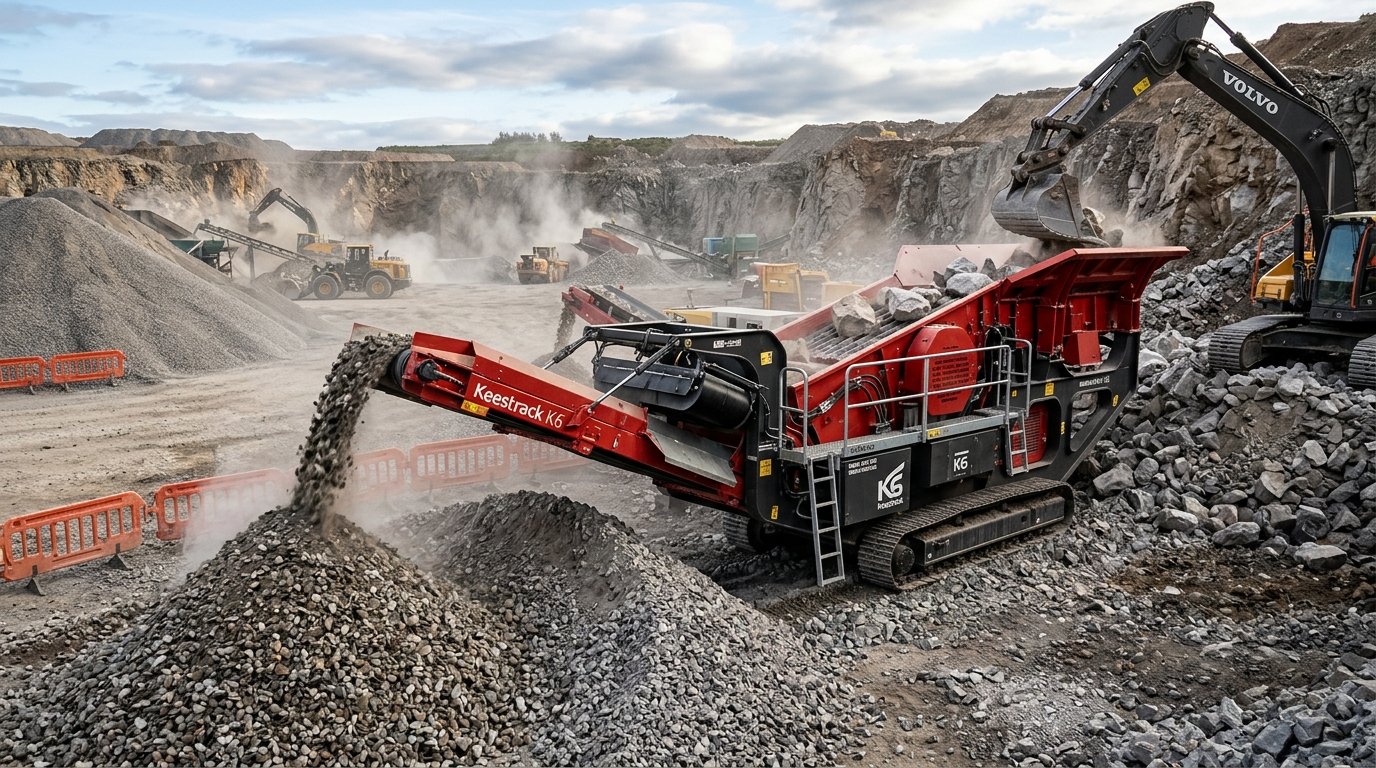
The rise of **compact, track-mounted portable stone crushers** has completely upended this linear expense model.
By processing bedrock, river cobble, and demolition concrete directly on the active jobsite, contractors convert heavy debris into high-value, certified aggregate on-demand, transforming a major cost center into a direct revenue driver.
Primary Crushing Technologies: Jaw vs. Impact Crushers
Selecting the correct crushing chamber design is critical to matching material hardness and target aggregate specifications:
1. Mobile Jaw Crushers (The Primary Reduction Workhorse) - **Mechanism:** Material drops between a stationary manganese steel jaw plate and an eccentric moving swing jaw that exerts crushing compressive forces. - **Best Suited For:** Hard, highly abrasive materials including granite, basalt, river boulders, and reinforced concrete containing embedded steel rebar. - **Key Advantage:** Extremely high reduction ratio (up to 6:1), low operating wear cost per ton, and exceptional rebar handling when equipped with an overband cross-belt magnet.
2. Mobile Horizontal Shaft Impactors (HSI) - **Mechanism:** Material enters a high-speed rotor chamber lined with heavy manganese or chrome blow bars, violently hurling rocks against stationary impact aprons. - **Best Suited For:** Softer, non-abrasive rock such as limestone, sandstone, asphalt pavement, and secondary aggregate shaping. - **Key Advantage:** Produces an exceptionally cubical, uniform aggregate shape with high production throughput, though wear part costs skyrocket if used in high-silica granite.
Economic Feasibility & Production Comparison Matrix
| Crusher Class & Configuration | Feed Opening Dimensions | Max Feed Size | Production Capacity (TPH) | Fuel Consumption (GPH) | Estimated Operating Cost / Ton |
|---|---|---|---|---|---|
| **Micro Tracked Crusher (12 Ton)** | 19" x 12" (480 x 300 mm) | 10" (250 mm) | 25 - 45 Tons / Hour | 2.5 - 3.8 GPH (9.5 - 14 L/h) | $4.50 - $6.50 / Ton |
| **Compact Jaw Crusher (20 Ton)** | 28" x 20" (700 x 500 mm) | 16" (400 mm) | 65 - 120 Tons / Hour | 4.5 - 6.5 GPH (17 - 25 L/h) | $3.20 - $4.80 / Ton |
| **Mid-Size Mobile Jaw (35 Ton)** | 40" x 26" (1000 x 650 mm) | 22" (550 mm) | 150 - 300 Tons / Hour | 8.0 - 12.0 GPH (30 - 45 L/h) | $2.10 - $3.40 / Ton |
| **Heavy Impactor (45 Ton)** | 44" x 32" (1120 x 810 mm) | 26" (650 mm) | 250 - 450 Tons / Hour | 12.0 - 18.0 GPH (45 - 68 L/h) | $2.80 - $4.20 / Ton |
Closed-Side Setting (CSS) & Sizing Quality Control
The physical gap between the bottom of the crusher jaws—known as the **Closed-Side Setting (CSS)**—governs the maximum particle size of the discharge aggregate:
Jobsite Environmental & Permitting Considerations
Deploying a mobile stone crusher in urban or suburban environments requires proactive dust and noise management:
Frequently Asked Questions
Q: Can recycled crushed concrete match the structural performance of virgin quarry aggregate? A: Yes. Recycled Concrete Aggregate (RCA) compacted as road base frequently outperforms virgin gravel. The unhydrated cement particles in crushed concrete recrystallize upon watering and compaction, delivering higher California Bearing Ratio (CBR) values than virgin limestone.
Q: What is the minimum project size required to make renting a mobile crusher profitable? A: As a rule of thumb, projects generating over **1,500 tons of clean rock or concrete** (approx. 75 tandem dump truck loads) justify mobilizing a compact track crusher. Savings in trucking and tipping fees immediately surpass machine rental and mobilization costs.
Q: What is the primary cause of jaw plate wear? A: High silica content in the feed rock. Processing quartz, quartzite, or sandstone induces rapid abrasive wear on manganese jaw plates. Always reverse jaw plates top-to-bottom at 50% wear to maximize total service life.
Explore TYPHON PROPACT Mini Excavators & Skid Steers
Compare engine horsepower, hydraulic breakout forces, and operating weights across TERROR XVII PRO Cabin, TERROR III, IV, and STOMP 65 loaders.