Road Roller Drum Weight & Dynamic Centrifugal Force in Soil & Asphalt Compaction
Explore the mechanics of compaction: compare static linear load vs dynamic centrifugal force, vibratory frequency, and amplitude in soil and asphalt paving.
Explore the mechanics of compaction: compare static linear load vs dynamic centrifugal force, vibratory frequency, and amplitude in soil and asphalt paving.
The Physics of Soil and Asphalt Consolidation
In civil construction and asphalt paving, achieving structural target density is non-negotiable. Whether preparing a sub-base for a commercial foundation or compacting a Superpave asphalt wearing course, failure to eliminate air voids leads to rutting, moisture intrusion, and pavement collapse.
A common misunderstanding is that compaction performance is governed solely by the machine's gross static weight. In reality, **static drum weight is merely the foundation**.
True compaction energy is generated through the dynamic interaction between: 1. **Static Linear Load (SLL):** The weight of the drum divided by the drum contact width (expressed in PLI or kg/cm). 2. **Centrifugal Force:** The dynamic kinetic energy produced by high-speed eccentric weights rotating inside the drum. 3. **Vibratory Amplitude and Frequency:** The physical travel distance and oscillation speed of the drum shell.
Static Linear Load (SLL) vs. Dynamic Vibratory Force
Static Compaction (Deadweight) In pure static mode, compaction relies entirely on the gravitational mass of the machine pressing down upon the material surface. - Static compaction is primarily effective in very thin lifts (under 2 inches) and on final "finish rolling" passes to iron out roller marks. - Deep compaction cannot be achieved statically without excessively heavy machines that crush surface aggregate.
Dynamic Vibratory Compaction Inside a modern vibratory roller drum, hydraulic motors spin eccentric weights at 2,400 to 4,200 vibrations per minute (VPM). - This rotational kinetic energy creates an alternating downward impact force that overcomes internal particle friction. - Soil and aggregate particles temporarily enter a fluid state, allowing gravity and centrifugal impact to rearrange them into a tightly interlocked, void-free matrix. - A 10-ton vibratory roller can produce over **50,000 lbs (222 kN) of dynamic compaction force**, delivering the compaction equivalent of a 30-ton static roller.
Technical Compaction Performance Matrix
| Roller Class & Application | Drum Width | Static Weight (Front/Rear) | Vibratory Frequency (Hz / VPM) | Centrifugal Force (kN / lbs) | Recommended Lift Thickness |
|---|---|---|---|---|---|
| **Walk-Behind Trench Roller** | 24 - 33 in (60 - 85 cm) | 3,200 lbs (1,450 kg) | 42 Hz (2,500 VPM) | 36 kN (8,100 lbs) | 8 - 12 in Cohesive Soil |
| **3.0-Ton Tandem Asphalt Roller** | 47 in (120 cm) | 6,600 lbs (3,000 kg) | 55 / 67 Hz (3,300/4,000 VPM) | 42 kN (9,450 lbs) | 1.5 - 2.5 in Asphalt Lift |
| **10-Ton Single Smooth Drum** | 84 in (213 cm) | 23,000 lbs (10,430 kg) | 30 / 36 Hz (1,800/2,160 VPM) | 225 kN (50,580 lbs) | 12 - 20 in Granular Base |
| **12-Ton Padfoot (Sheepsfoot)** | 84 in (213 cm) | 26,500 lbs (12,020 kg) | 28 / 34 Hz (1,680/2,040 VPM) | 280 kN (62,940 lbs) | 15 - 24 in Cohesive Clay |
Matching Amplitude and Frequency to Material Types
High Amplitude / Low Frequency (Sub-Base & Cohesive Soils) - **Settings:** Amplitude: 1.5 to 2.1 mm; Frequency: 25 to 32 Hz (1,500–1,900 VPM). - **Application:** Deep soil lifts, cohesive clays, and large pit-run aggregate. Heavy downward impacts shatter soil moisture tension and drive air voids out from deep beneath the surface.
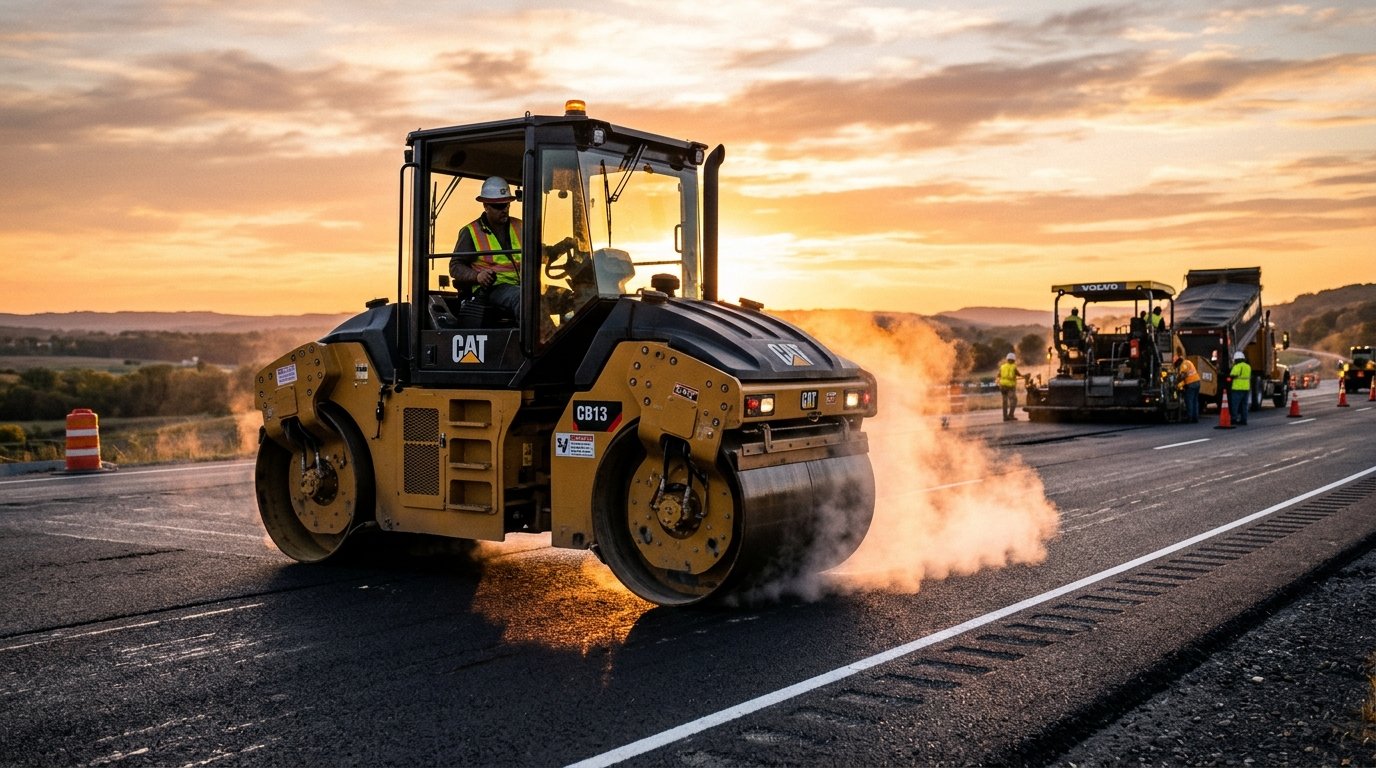
Low Amplitude / High Frequency (Asphalt Wearing Courses) - **Settings:** Amplitude: 0.3 to 0.6 mm; Frequency: 50 to 70 Hz (3,000–4,200 VPM). - **Application:** Hot Mix Asphalt (HMA) and thin aggregate toppings. High frequency delivers rapid, closely spaced impacts (10 to 14 impacts per linear foot) to achieve smooth, crack-free pavement density without fracturing aggregate stones.
Critical Compaction Mistakes to Avoid
1. **Over-Compaction and Aggregate Shattering:** Continuing to vibrate on an already compacted sub-base fractures stone aggregate into dust, actually decreasing CBR load-bearing capacity. Always verify density using nuclear or non-nuclear gauges. 2. **Rolling Cold Asphalt:** Once asphalt temperature drops below the "cessation temperature" (typically 175°F / 80°C), vibratory compaction will crush the aggregate skeleton and crack the mat. Complete breakdown rolling while the mat is between 240°F and 300°F. 3. **Sudden Stops and Starts:** Never stop a roller on hot asphalt with the vibrator active; this creates permanent dips and waves in the finished roadway.
Frequently Asked Questions
Q: When should I choose a padfoot (sheepsfoot) roller over a smooth drum roller? A: Choose a padfoot roller for cohesive clay and silty soils. The tapered steel pads penetrate deep into the lift, compacting from the bottom upward and kneading the clay. Smooth drum rollers are strictly designed for granular gravel, sand, and asphalt.
Q: What is Intelligent Compaction (IC)? A: Intelligent Compaction integrates GPS mapping and drum accelerometers to continuously measure material stiffness in real time. The roller automatically adjusts vibratory amplitude and notifies the operator when 100% target density is achieved, preventing over-compaction.
Q: Why do asphalt rollers require water spray systems on the drums? A: Hot asphalt binder (bitumen) sticks aggressively to cold steel drums, tearing chunks out of the newly laid mat. Continuous pressurized water spray creates a lubricating boundary layer that prevents asphalt pick-up.
Explore TYPHON PROPACT Mini Excavators & Skid Steers
Compare engine horsepower, hydraulic breakout forces, and operating weights across TERROR XVII PRO Cabin, TERROR III, IV, and STOMP 65 loaders.