Skid Steer Horsepower vs. Hydraulic Flow: Matching GPM & PSI to Attachments
Master hydraulic horsepower: understand why high engine HP does not guarantee attachment performance without matching GPM and relief pressure (PSI).
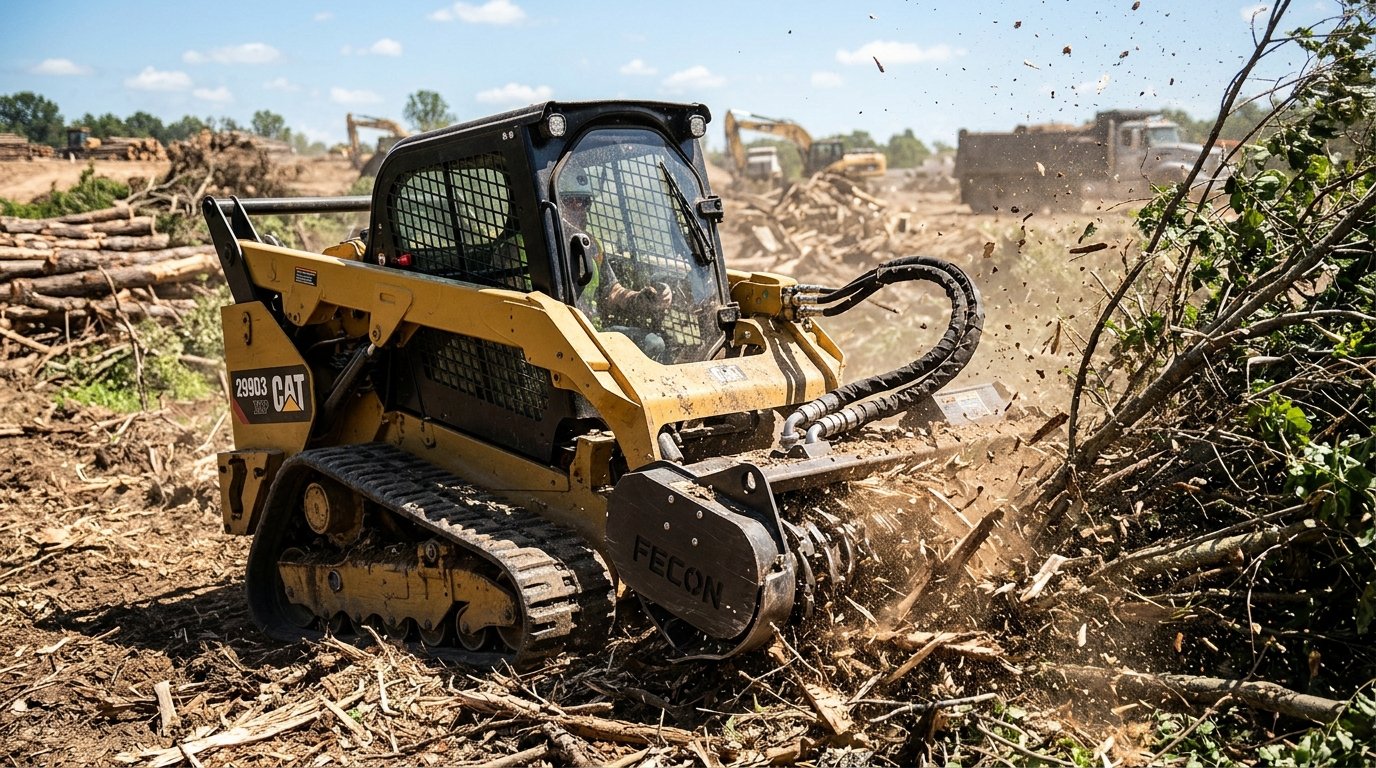
Master hydraulic horsepower: understand why high engine HP does not guarantee attachment performance without matching GPM and relief pressure (PSI).
The Mathematical Fallacy of Engine Horsepower
When selecting a skid steer loader or compact track loader (CTL) for severe attachment work—such as forestry mulching, asphalt milling, or trenching—contractors frequently look at a single brochure metric: **Engine Gross Horsepower**.
This is a dangerous and costly oversimplification.
An engine rated at 90 horsepower can easily produce less working attachment power than a 74-horsepower machine if the hydraulic system is poorly matched.
Attachments do not consume diesel fuel or engine torque directly; they consume **Hydraulic Fluid Power**. Hydraulic power is governed by two distinct variables: **Flow Rate (Gallons Per Minute / GPM)** and **Operating Pressure (Pounds Per Square Inch / PSI)**. Understanding this relationship is critical to maximizing attachment efficiency.
The Hydraulic Horsepower Formula
In fluid power engineering, the actual usable power delivered to your hydraulic attachment motor is calculated using this fundamental formula:
$$\text{Hydraulic Horsepower (HHP)} = \frac{\text{GPM} \times \text{PSI}}{1714}$$
Where:
The Real-World Calculation Consider two machines: 1. **Machine A:** 85 HP Engine, Standard Hydraulic Flow: 22 GPM @ 3,000 PSI $$\text{HHP} = \frac{22 \times 3000}{1714} = 38.5\text{ Hydraulic HP}$$ 2. **Machine B:** 74 HP Engine, High-Flow Hydraulic Option: 35 GPM @ 3,500 PSI $$\text{HHP} = \frac{35 \times 3500}{1714} = 71.4\text{ Hydraulic HP}$$
Despite having 11 fewer engine horsepower, **Machine B delivers nearly DOUBLE the actual hydraulic cutting power** to the attachment!
Standard Flow vs. High Flow vs. Enhanced High Flow
| Hydraulic System Tier | Flow Rate Range (GPM) | System Pressure (PSI) | Usable Hydraulic HP | Typical Attachment Compatibility |
|---|---|---|---|---|
| **Standard Auxiliary Flow** | 15 - 23 GPM (57 - 87 L/min) | 2,800 - 3,300 PSI | 25 - 44 HHP | Dirt augers, light sweepers, standard trenchers, grapple buckets |
| **High Flow (Standard HF)** | 26 - 36 GPM (98 - 136 L/min) | 3,000 - 3,500 PSI | 50 - 73 HHP | Heavy brush cutters, 48" trenchers, snow blowers, cold planers |
| **Enhanced High Flow (Super HF)** | 38 - 45 GPM (144 - 170 L/min) | 4,000 - 4,500 PSI | 90 - 118 HHP | Severe forestry mulchers, rock saws, 24"+ high-production cold planers |
Hydraulic Line Routing, Heat Dissipation, and Thermal Losses
Delivering 40+ GPM through a compact loader creates immense thermal friction:
Frequently Asked Questions
Q: Can I run a high-flow attachment on a standard-flow skid steer? A: No. A high-flow attachment connected to a standard-flow machine will run at half speed, stall constantly, and fail to generate sufficient cutting momentum. Some attachments with variable-displacement motors can be reconfigured, but performance will be severely hampered.
Q: Does running high flow burn significantly more diesel? A: Yes. Because the hydraulic pump demands 60 to 90 HP from the engine continuously, the engine operates near 100% load factor. Expect fuel consumption to increase from 2.5–3.5 GPH during dirt loading to 5.5–7.5 GPH during high-flow forestry mulching.
Q: What happens if hydraulic fluid gets too hot during mulching? A: Operating hydraulic oil above 185°F (85°C) degrades the oil's viscosity index, accelerates oxidation, and ruins Buna-N/Viton seals. It also causes hydraulic cavitation in hydrostatic piston pumps, leading to catastrophic internal metal-on-metal wear.
Explore TYPHON PROPACT Mini Excavators & Skid Steers
Compare engine horsepower, hydraulic breakout forces, and operating weights across TERROR XVII PRO Cabin, TERROR III, IV, and STOMP 65 loaders.