Skid Steer Traction & Ground Pressure: Wheels vs. Tracks on Mud, Slopes, and Turf
Wheels vs tracks: analyze ground contact pressure (PSI), tractive push force, slope stability, undercarriage wear costs, and turf protection.
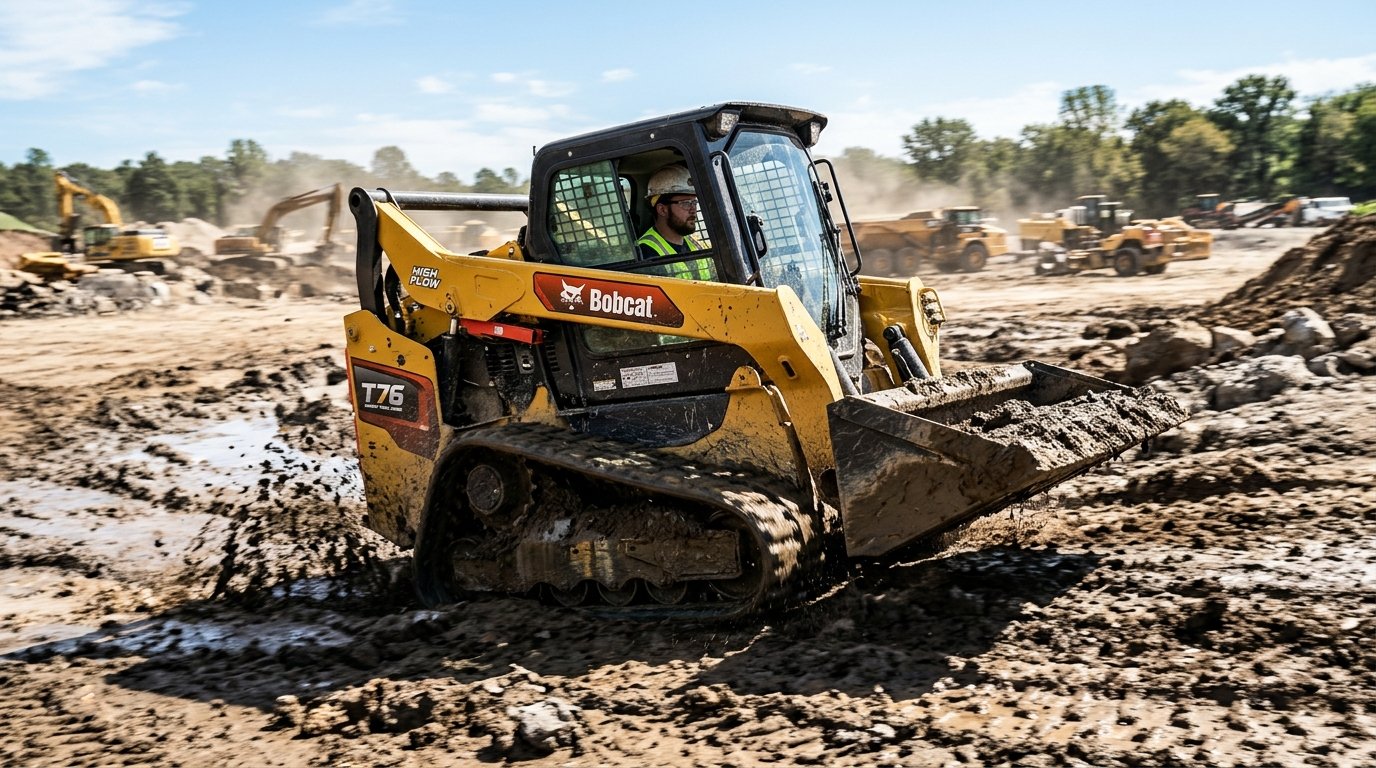
Wheels vs tracks: analyze ground contact pressure (PSI), tractive push force, slope stability, undercarriage wear costs, and turf protection.
The Tractive Dilemma: Wheeled Skid Steer (SSL) vs. Tracked Loader (CTL)
Selecting between a traditional four-wheeled Skid Steer Loader (SSL) and a rubber-tracked Compact Track Loader (CTL) is one of the most critical fleet investment decisions a contractor will make.
While both machine formats share identical cabs, quick-attach hydraulic interfaces, and boom geometries, their ground interfaces create completely divergent performance profiles.
The central physics distinction lies in **ground bearing pressure and contact footprint area**.
A standard 8,500 lb wheeled skid steer concentrates its entire mass onto four relatively small tire contact patches, generating ground contact pressures between **32 and 40 PSI**. An identically sized tracked loader disperses its mass across continuous rubber tracks, slashing ground contact pressure to a mere **4.0 to 4.8 PSI**—less than the human footprint!
Comparative Performance on Different Terrains
1. Mud, Wet Silt, and Saturated Subgrades - **Compact Track Loader (Winner):** The CTL floats over deep mud where a wheeled machine immediately sinks to its belly pan. Tracks provide unbroken tractive shear along the ground, enabling earthmoving and loading operations in torrential spring thaws that shut down wheeled fleets. - **Wheeled Skid Steer:** Narrow tires quickly dig ruts, spin uncontrollably, and high-center on uncompacted soil, leading to lost billable hours and expensive recovery towing.
2. Hard Concrete, Asphalt, and Demolition Scrap - **Wheeled Skid Steer (Winner):** Hard, abrasive pavement is the natural domain of the wheeled skid steer. Pneumatic or foam-filled severe-duty tires withstand jagged concrete, scrap steel, and rebar with minimal wear. Solid cushion tires eliminate flat tires completely. - **Compact Track Loader:** Concrete and asphalt chew through expensive rubber track lugs rapidly. Furthermore, making sharp counter-rotational skids on abrasive pavement induces immense scrub friction, stripping track guide blocks and cutting track lifespan by over 50%.
3. Finished Residential Turf and Landscaping - **Compact Track Loader (Winner):** Wide rubber tracks with multi-bar or zig-zag tread patterns distribute machine weight evenly, allowing gradual turns without tearing established lawns. - **Wheeled Skid Steer:** When a wheeled skid steer turns, its tires must skid laterally across the turf. This gouges deep circular ruts, completely destroying sod and requiring extensive manual lawn restoration.
Technical Specifications: SSL vs. CTL Performance Matrix
| Performance Variable | Wheeled Skid Steer Loader (SSL) | Compact Track Loader (CTL) |
|---|---|---|
| **Average Ground Bearing Pressure** | 30.0 - 45.0 PSI (High Ground Damage) | 3.8 - 5.0 PSI (Ultra-Low Disturbance) |
| **Max Drawbar Pull / Pushing Force** | ~50% - 60% of Operating Mass | ~85% - 95% of Operating Mass |
| **Max Travel Speed** | 7.5 - 12.5 mph (12 - 20 km/h) | 6.0 - 10.0 mph (9.6 - 16 km/h) |
| **Slope Stability Limit (Grading)** | 20° - 25° Maximum Incline | 30° - 35° Maximum Incline |
| **Operating Cost per Hour (Undercarriage)** | $1.80 - $3.50 / Hour (Tires) | $5.50 - $9.50 / Hour (Tracks, Sprockets, Rollers) |
| **Performance on Soft Sand / Snow** | Poor (High Sinking Probability) | Outstanding (High Floatation) |
The Financial Equation: Undercarriage Operating Expenses
While tracked loaders offer vastly superior pushing power and all-weather traction, contractors must budget for significantly higher undercarriage maintenance:
Frequently Asked Questions
Q: What are Over-The-Tire (OTT) steel tracks? A: OTT tracks are steel segmented tracks installed directly over pneumatic tires on a wheeled skid steer. They provide an economical middle-ground, adding floatation and steel-grouser traction in mud while allowing removal for pavement work.
Q: Why do tracked loaders push dirt piles so much harder than wheeled loaders? A: Traction is governed by total contact surface area and friction coefficient. Because CTL rubber tracks maintain hundreds of square inches of continuous ground contact, they convert over 85% of engine tractive torque into pushing power without wheel spin.
Q: How can an operator extend rubber track life on a CTL? A: Avoid aggressive counter-rotation (spinning in place like a tank). Always make gradual three-point Y-turns, keep track tension calibrated within manufacturer specifications, and avoid driving over curbs or sharp demolition rubble.
Explore TYPHON PROPACT Mini Excavators & Skid Steers
Compare engine horsepower, hydraulic breakout forces, and operating weights across TERROR XVII PRO Cabin, TERROR III, IV, and STOMP 65 loaders.