Steel Tracks vs. Rubber Tracks for Mini Excavators: Wear Life, Ground Disturbance & Cost
Steel vs rubber tracks on mini excavators: compare operating lifespan, jagged rock durability, ground disturbance, track noise, and hourly operating costs.
Steel vs rubber tracks on mini excavators: compare operating lifespan, jagged rock durability, ground disturbance, track noise, and hourly operating costs.
The Undercarriage Dilemma in the 3-Ton to 8-Ton Class
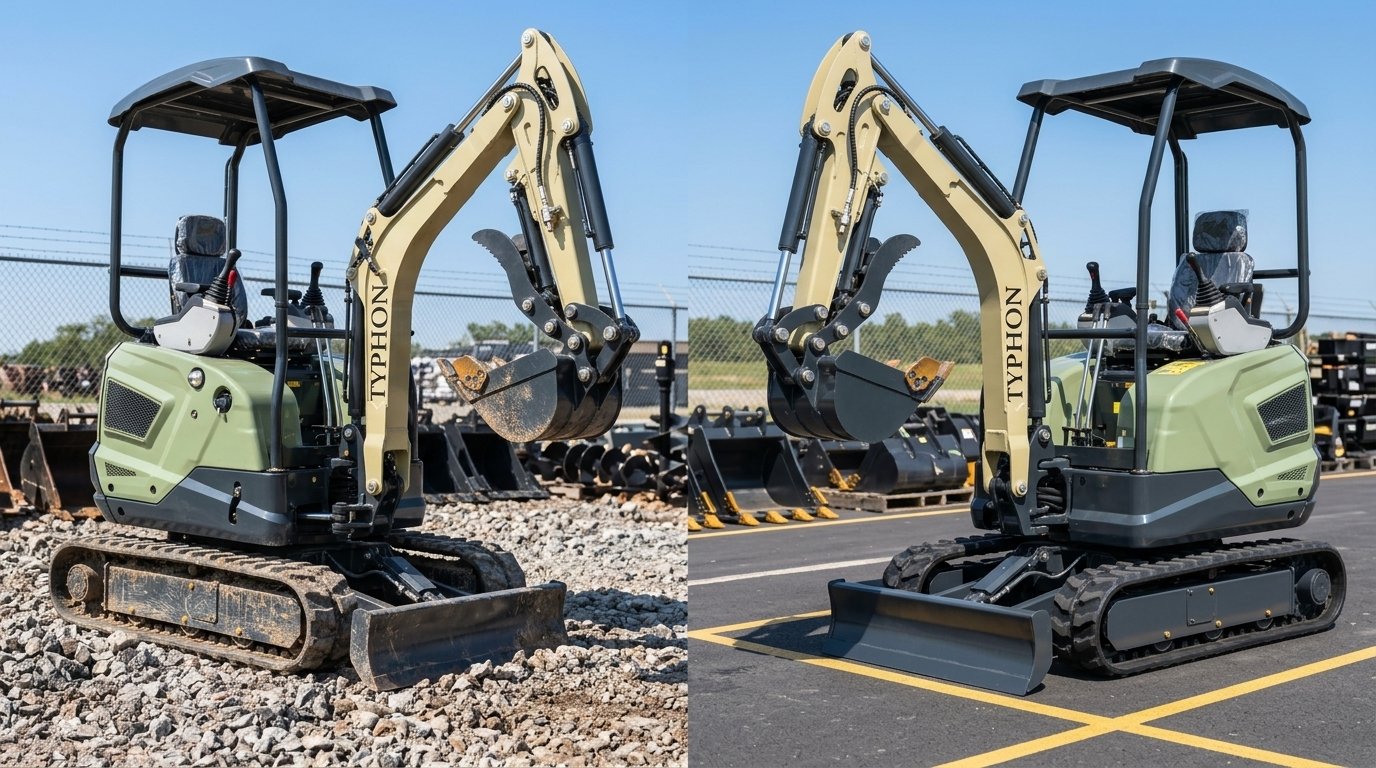
When configuring a **TYPHON Machinery compact excavator** (such as the TERROR XVII PRO or TERROR XXV), contractors routinely face a pivotal undercarriage specification: **Continuous Rubber Tracks vs. Steel Track Shoes**.
In the compact excavator market (under 6 tons), continuous rubber tracks dominate dealer lots due to their versatility in urban environments. However, as machines push into the 5.0 to 8.5 ton "midi" excavator weight class—or operate in severe demolition, forestry, and fractured rock quarries—rubber tracks experience accelerated gouging, cord severance, and premature de-tracking.
Understanding the direct trade-offs between **ground surface protection, jagged-rock puncture resistance, track service life, and operating cost per hour** allows fleet managers to select the optimum track configuration for their specific operating profile.
Comparative Structural Architecture
1. Continuous Rubber Tracks Constructed from vulcanized synthetic/natural rubber compounds wrapping internal continuous high-tensile spiral wound steel cords and forged steel drive links. - **Primary Advantages:** Zero pavement damage on finished asphalt or concrete; low ground vibration; ultra-quiet travel; minimal turf disturbance in residential landscaping. - **Vulnerabilities:** Susceptible to sidewall cuts, internal steel cord rust from moisture intrusion, and catastrophic tearing when tracking over sharp jagged demolition rebar, broken glass, or blasted shale.
2. Steel Grouser Tracks Composed of induction-hardened forged steel link chains pinned together with sealed bushings, carrying bolt-on single-, double-, or triple-grouser steel track pads. - **Primary Advantages:** Virtually indestructible in sharp fractured granite, blasted basalt, and demolition slag. Delivers unmatched traction on steep rocky mountain hillsides. - **Vulnerabilities:** Destroys finished roadway asphalt, concrete sidewalks, and turf instantly. Heavier rotating mass increases tracking noise and ground vibration.
Technical Performance & Economic Lifespan Matrix
| Performance Variable | Continuous Rubber Tracks | Heavy-Duty Steel Tracks | Hybrid Bolt-On Rubber Pads (Roadliners) |
|---|---|---|---|
| **Typical Service Lifespan** | 1,000 - 1,500 Hours | **3,000 - 4,500 Hours** | 2,000 - 2,500 Hours (Replaceable Pads) |
| **Ground Damage on Pavement** | **None (Zero Surface Damage)** | Severe (Cracks asphalt & concrete) | None (Rubber pads protect pavement) |
| **Puncture & Tear Resistance** | Low to Moderate | **Impervious (Zero Puncture Risk)** | High (Steel core absorbs loads) |
| **Traction on Fractured Rock** | Poor (Rubber slips on wet stone) | **Outstanding (Grousers bite rock)** | Moderate to High |
| **Track Weight (Adds to Stability)** | Standard Base Weight | **+65% to +85% Heavier** | +70% Heavier (Enhanced low CoG) |
| **Average Initial Cost (Set)** | $1,600 - $2,800 | $3,800 - $6,200 | $4,500 - $7,000 |
| **Hourly Undercarriage Cost** | **$1.60 - $2.40 / Hour** | **$1.10 - $1.60 / Hour** | $1.40 - $2.00 / Hour |
The Heavy Counterweight Advantage of Steel Tracks
An often-overlooked engineering benefit of steel tracks is **counterbalance stability**:
The Hybrid Alternative: Roadliner Bolt-On Rubber Pads
For contractors demanding the puncture-proof durability of steel link chains with the surface protection of rubber, **Hybrid Bolt-On Rubber Pads (Roadliners)** represent the perfect compromise:
Frequently Asked Questions
Q: Can I convert my rubber-tracked excavator to steel tracks later? A: Yes. On TYPHON Machinery excavators (including the TERROR XVII PRO and TERROR XXV), the undercarriage frames are engineered to accept both continuous rubber tracks and heavy-duty steel grouser assemblies. The undercarriage frames, track rollers, and drive motors are designed to accept either configuration. However, you will need to replace the drive sprockets, track guides, and tension idler wheels to match the steel chain pitch.
Q: Why do steel tracks last three times longer than rubber tracks? A: Steel links are induction-hardened to withstand severe friction wear and are lubricated internally with sealed grease pins. Unlike rubber compounds that degrade under UV light, ozone, and oil contamination, steel track chains tolerate extreme environmental exposure.
Q: Which track type is safer on steep muddy slopes? A: In deep mud over rock, steel grouser tracks provide vastly superior safety. Rubber tracks act like smooth skis on wet rock, causing dangerous uncontrolled downhill slides, whereas steel grouser bars penetrate the mud layer and bite into the underlying bedrock.
Explore TYPHON PROPACT Mini Excavators & Skid Steers
Compare engine horsepower, hydraulic breakout forces, and operating weights across TERROR XVII PRO Cabin, TERROR III, IV, and STOMP 65 loaders.