Maximizing Skid Steer Loading Productivity: Two-Speed Transmissions & Cycle Times
Analyze cycle time efficiency: how two-speed hydrostatic drive motors, ride control accumulators, and vertical lift geometry increase loading productivity by 40%.
Analyze cycle time efficiency: how two-speed hydrostatic drive motors, ride control accumulators, and vertical lift geometry increase loading productivity by 40%.
The Arithmetic of Earthmoving: Deconstructing the Load Cycle
In commercial earthmoving and aggregate handling, equipment profitability is governed by a simple metric: **Tons of Material Moved Per Hour**.
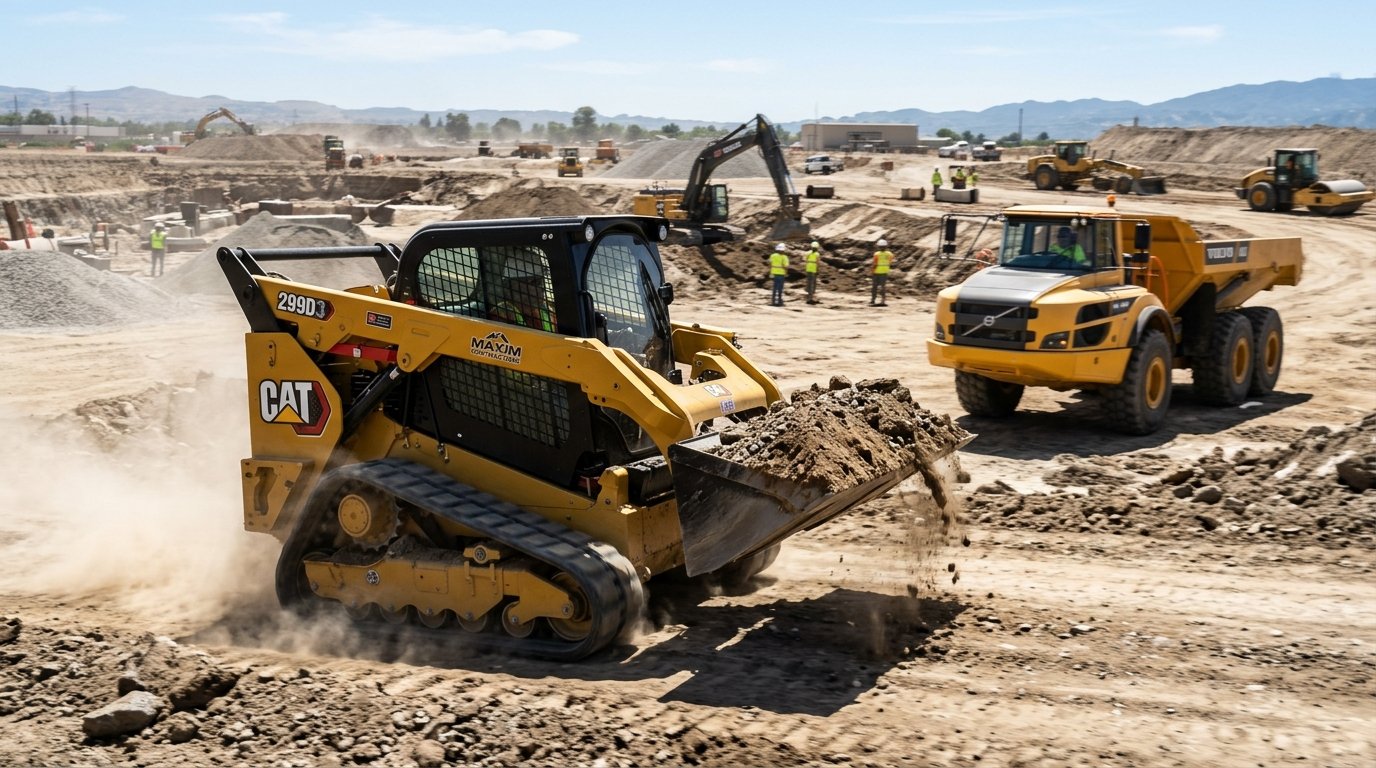
When loading a fleet of 10-wheel dump trucks or charging a concrete batch plant hopper, an operator executes a repetitive, four-phase operational cycle: 1. **Penetrate & Fill Bucket** (Digging Phase) 2. **Back Out & Rotate** (Transition Phase) 3. **Travel to Dump Target** (Haul Phase) 4. **Elevate, Dump & Return** (Discharge & Return Phase)
While bucket capacity dictates volume per scoop, **travel velocity and transition efficiency govern total daily volume**.
Integrating advanced two-speed hydrostatic drive transmissions, hydraulic ride control accumulators, and vertical-lift loader linkage geometry can reduce average cycle times from 42 seconds down to 26 seconds—yielding an astonishing **38% increase in daily billable productivity**.
Single-Speed vs. Two-Speed Hydrostatic Drive Motors
Standard compact loaders feature fixed-displacement single-speed hydraulic drive motors, capping top travel speed at approximately **6.0 to 7.0 MPH (9.6 to 11.2 km/h)**.
Modern commercial machines incorporate **variable-displacement, two-speed bent-axis piston motors**:
Technical Cycle Time & Productivity Matrix
| Machine Configuration | Haul Distance | Average Cycle Time | Cycles Per 50-Min Hour | Hourly Production (1.0 yd³ Bucket) |
|---|---|---|---|---|
| **Single-Speed / Standard Boom** | 50 ft (15 m) | 32 Seconds | 93 Cycles | **93.0 yd³ / Hour (116 Tons)** |
| **Two-Speed / Vertical Lift Boom** | 50 ft (15 m) | 24 Seconds | 125 Cycles | **125.0 yd³ / Hour (156 Tons)** |
| **Single-Speed / Standard Boom** | 150 ft (45 m) | 48 Seconds | 62 Cycles | **62.0 yd³ / Hour (77 Tons)** |
| **Two-Speed / Ride Control Active** | 150 ft (45 m) | 31 Seconds | 96 Cycles | **96.0 yd³ / Hour (120 Tons)** |
Hydraulic Ride Control: Eliminating Spoil Spillage
Traveling at 12 MPH across a bumpy construction site creates immense vertical pitching:
Vertical Lift vs. Radial Lift Boom Geometries
Bucket linkage geometry fundamentally dictates truck-loading efficiency:
Frequently Asked Questions
Q: When should an operator shift down from high speed to low speed? A: Always shift into low speed *before* penetrating a pile. Entering a heavy aggregate pile in high speed starves the hydrostatic motors of tractive torque, spikes hydraulic relief pressure, and creates wheel spin. Use high speed exclusively for empty and loaded transit.
Q: Does using two-speed travel increase track and tire wear? A: No, provided turns are made gradually. Tire and track wear occurs during aggressive counter-rotational skidding and wheel spin, not straight-line travel. Two-speed transport reduces overall wheel spin cycles.
Q: How much does Hydraulic Ride Control improve resale value? A: Contractors and auction buyers heavily prioritize ride control on secondary markets. Beyond boosting productivity, ride control protects the chassis frame and loader arm pins from dynamic shock cracking, significantly preserving machine structural integrity.
Explore TYPHON PROPACT Mini Excavators & Skid Steers
Compare engine horsepower, hydraulic breakout forces, and operating weights across TERROR XVII PRO Cabin, TERROR III, IV, and STOMP 65 loaders.