Why Electric Scissor Lift Battery Capacity Must Match Jobsite Duty Cycles
Analyze deep-cycle lead-acid vs lithium-ion scissor lift batteries: understand Amp-Hour ratings, the Peukert effect, cold-weather voltage drops, and duty cycles.
Analyze deep-cycle lead-acid vs lithium-ion scissor lift batteries: understand Amp-Hour ratings, the Peukert effect, cold-weather voltage drops, and duty cycles.
The Reality of Aerial Equipment Power Systems
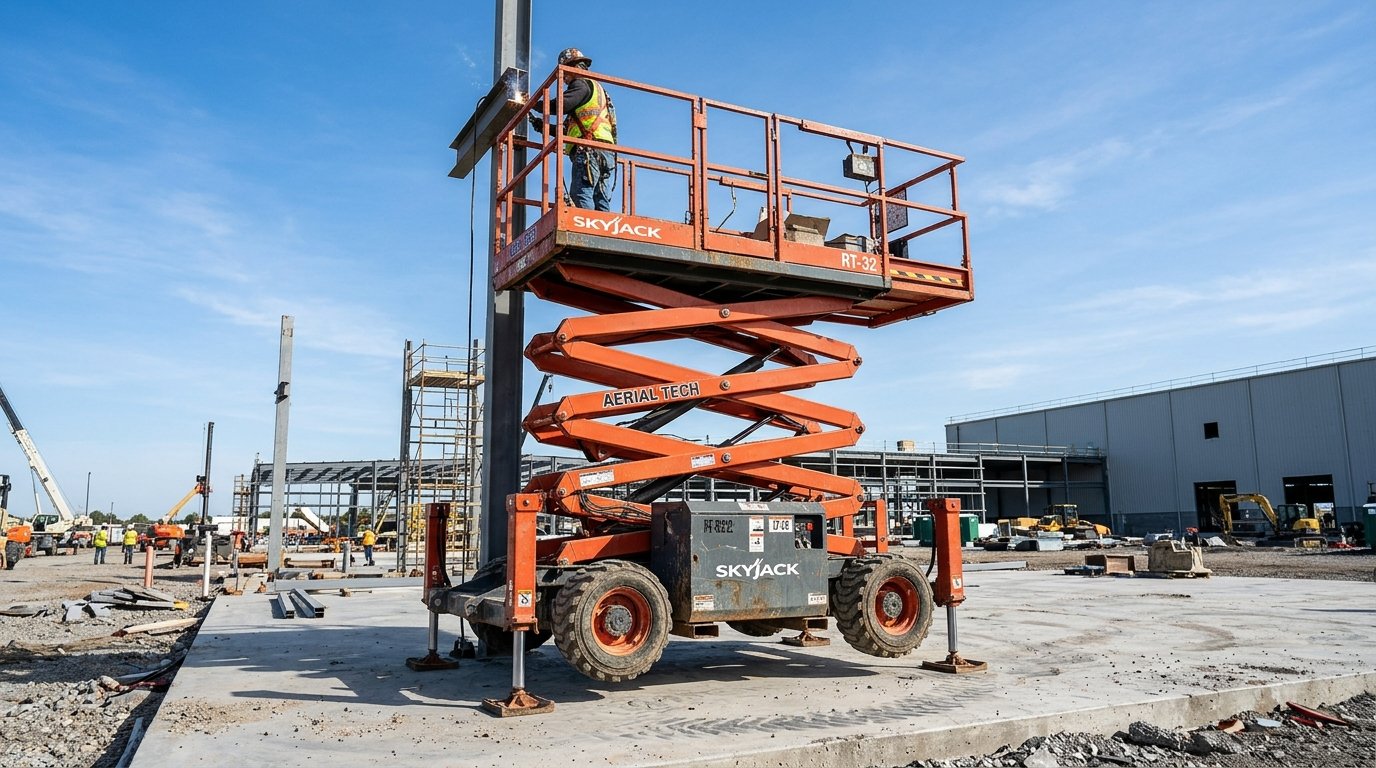
In commercial indoor construction, electrical contracting, and facility maintenance, slab electric scissor lifts are the undisputed standard. However, an all-too-common jobsite disruption is the **mid-shift dead lift**—a scissor lift stuck elevated or stranded in an access aisle by 1:30 PM due to a depleted battery.
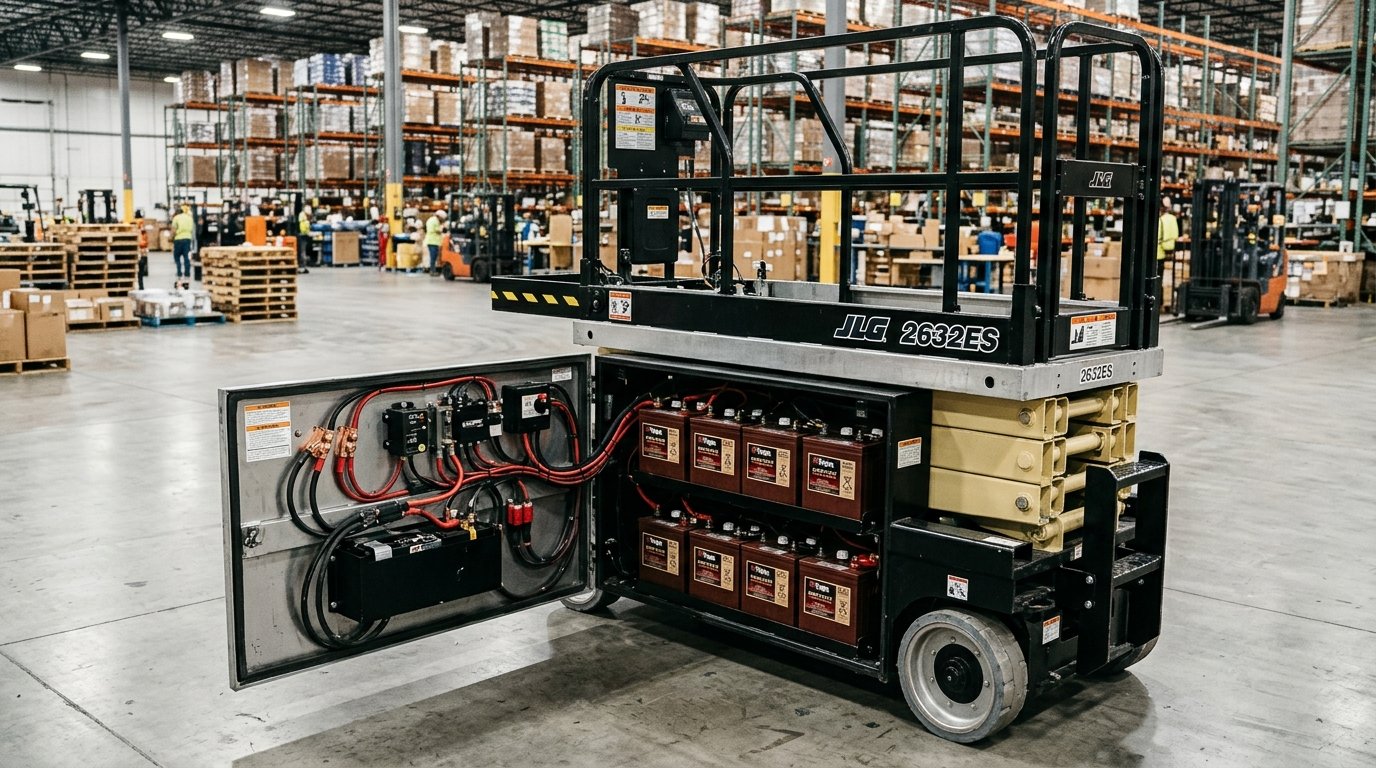
A scissor lift battery system is not merely an auxiliary starting battery; it is the entire machine's fuel tank, hydraulic pump powerplant, and electric drive motor energy source.
When battery capacity (measured in Ampere-Hours / Ah) is mismatched to the jobsite's real-world duty cycle, contractors face severe productivity crashes, ruined battery chemistry, and expensive replacement cycles.
Deep-Cycle Flooded Lead-Acid vs. AGM vs. Lithium-Ion (LiFePO4)
1. Flooded Lead-Acid (FLA) Batteries The traditional standard in rental fleets due to low initial acquisition cost. - **Usable Depth of Discharge (DoD):** Maximum 50% to 60%. Discharging below 50% causes irreversible lead sulfate plate crystallization. - **Maintenance Requirements:** High. Requires regular demineralized water topping and terminal corrosion cleaning. - **Cycle Life:** Approximately 500 to 800 charge cycles under ideal care.
2. Lithium Iron Phosphate (LiFePO4) Batteries The modern standard for commercial fleets and high-demand operations. - **Usable Depth of Discharge (DoD):** 90% to 100% without chemical degradation. - **Maintenance Requirements:** Zero. Fully sealed with integrated Battery Management System (BMS). - **Opportunity Charging:** Can be fast-charged during a 30-minute lunch break without memory effect or sulfation damage. - **Cycle Life:** 3,000 to 5,000+ full charge cycles (often outliving the mechanical chassis).
Technical Performance Matrix: Battery Chemistry Comparison
| Parameter / Metric | Deep-Cycle Flooded Lead-Acid (4x 6V) | AGM Maintenance-Free (4x 6V) | Lithium-Ion (LiFePO4 24V/48V) |
|---|---|---|---|
| **Typical Nominal Capacity** | 225 - 245 Ah @ 20-Hr Rate | 200 - 220 Ah @ 20-Hr Rate | 150 - 200 Ah (True Usable) |
| **Usable Energy Per Shift** | ~2.6 kWh (at 50% DoD) | ~2.4 kWh (at 50% DoD) | ~4.8 kWh (at 95% DoD) |
| **Full Recharging Time** | 8 - 12 Hours Continuous | 8 - 10 Hours Continuous | 2 - 3 Hours Fast-Charge |
| **Cold Temperature Derating (at 32°F / 0°C)** | -35% Available Capacity | -25% Available Capacity | -10% Available Capacity (with heaters) |
| **Weight per Pack** | ~260 - 300 lbs (118 - 136 kg) | ~280 - 320 lbs (127 - 145 kg) | ~85 - 110 lbs (38 - 50 kg) |
| **Operating Lifespan** | 2 - 3 Years | 3 - 4 Years | 8 - 10 Years |
The Peukert Effect & High-Elevation Heavy Lifts
One of the most misunderstood phenomena in lead-acid battery performance is the **Peukert Effect**:
Cold-Weather Performance Hazards
Operating in unheated buildings or outdoor winter construction severely degrades battery chemistry:
Frequently Asked Questions
Q: Can I opportunity-charge my lead-acid scissor lift during lunch breaks? A: It is strongly discouraged for flooded lead-acid batteries. Short 30-minute charging cycles induce heat, accelerate water evaporation, and count toward the battery's finite total cycle life without achieving complete desulfation. Lithium-ion batteries, by contrast, excel at opportunity charging.
Q: Why do scissor lift motors slow down when the battery reaches 25%? A: As lead-acid batteries discharge, their voltage steadily drops from 25.4V to below 22.0V. Because electric motor RPM is directly proportional to supply voltage, the pump motor slows down, doubling lift cycle times.
Q: What is the primary cause of premature scissor lift battery death? A: Chronic undercharging and neglecting water replenishment. Allowing battery plates to remain partially discharged creates hard lead sulfate crystals that permanently reduce capacity, while exposed dry plates oxidize and warp.
Explore TYPHON PROPACT Mini Excavators & Skid Steers
Compare engine horsepower, hydraulic breakout forces, and operating weights across TERROR XVII PRO Cabin, TERROR III, IV, and STOMP 65 loaders.